Butterfly shrimp – Feng Wei Xia

Ingrédients :

  • 500 g of raw shrimp
  • 1 teaspoon of ground Sichuan pepper
  • 1 tablespoon of light soy sauce
  • 1 tablespoon of rice wine or dry sherry
  • 2 teaspoons of cornstarch mixed with a little water
  • Oil for frying
  • 2 eggs
  • 5 tablespoons of bread crumbs
  • 10 g of spring onions
  • a few lettuce leaves

Préparation :

Shell the prawns leaving the tails. Cut them into 2 in lengthwise on the belly, leaving the tails firmly attached.

In a bowl marinate the prawns with pepper, the soy sauce, the rice wine and cornstarch for 15 minutes.

Meanwhile, heat oil on medium heat in a deep fryer to a medium temperature.

Beat eggs slightly, dip except the tail, prawns one by one in the egg and then roll them in bread crumbs.

Gently place the prawns in oil and fry until nicely browned. Remove them and drain them on absorbent paper.

Place them on a bed of lettuce and garnish with scallions.

Serve hot with white rice and a spicy or sweet and sour sauce.

Tip : You can also replace the salad by the crispy seaweed (fried) and replace prawns with shrimps.

Okonomiyaki – japanese crepe

Ingrédients :

  • 150 g of flour of okonomiyaki or simple flour
  • 1 tablespoon of cornstarch
  • 2 eggs
  • 15 cl of water
  • 1 teaspoon of dashi
  • 8 thin slices of pork belly
  • 100 g of prawns
  • 2 green onions
  • ¼ white cabbage
  • ½ leek
  • dried bonito flakes
  • okonomiyaki sauce
  • mayonnaise
  • oil

Préparation :

Chop the cabbage into thin strips and the leek, then shell the shrimp and remove the black vein and cut into small pieces.

In a bowl put the flour, cornstarch, egg, water and dashi and mix well until that it be homogenous, then add cabbage, leeks, prawns and mix well.

Heat skillet lightly oiled on medium heat, put 4 slices of pork and pour over half the dough and spread well, cover and cook 5 minutes. Check the vegetables is cooked.

Then flip the okonomiyaki with a plate and cook 5 minutes, uncovered.

Serve hot, brush the crepe with okonomiyaki sauce and a little mayonnaise and then sprinkle with dried bonito.

Tips : you can put all the ingredients you love, as squid, cuttlefish, mushrooms, raw eggs, onions, green onions, cheese, and kimchi, Japanese noodles (soba).

Anecdotes : The okonomiyaki is a pancake or pizza typically Japanese. “Okonomi” means “what you like / want” and “yaki” means “grilled”. This name comes from the fact that we can put many ingredients (although mostly time we find mainly cabbage).

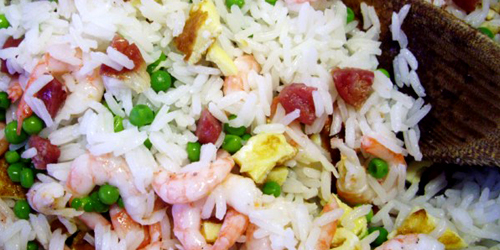
Typical Chinese fried rice

Ingredients :

  • 3 cups of white rice
  • 6 cups of water
  • 10 raw shrimp pink
  • 3 eggs
  • 1 carrot
  • 1 box of peas
  • 1 box of corn
  • 50 g of soy grows
  • 6 sprigs chives
  • 125 g of pork or ready lacquered Chinese sausages 4
  • 2 tablespoon of light soy sauce
  • 1 teaspoon of salt
  • oil

Preparation :

Wash 3 to 4 times the rice and cook in a rice-cooker, for 3 cups of rice put 6 cups of water.

Drain and rinse the corn and the little peas and the growth of soybeans. Chop the stems of chinese chives.

Peel and wash the carrots and cut the small dice.

Cut small dice of the pork lacquered, if you take the Chinese sausage cooked before around 15 minutes in boiling water, dry thoroughly and cut into small dice. Set aside.

Shell the shrimp and made ​​a small cut on the back of the shrimp and remove the black vein.

Break eggs and beat them to make an omelet.

Heat wok over high heat, put oil then pour the egg and well spread for much faster cooking, then cut it into pieces and place in a plate and set aside.

Add a little oil in the wok and add the shrimp and saute until they change color, then add carrots, peas, corn, lacquered pork or Chinese sausages and finally growth of soybean. Let cook 2 to 3 minutes, stirring occasionally.

Add rice, pieces of omelette, the chives and soy sauce and stir so that all is well blended and season with salt.

Tips : For the fried rice you can use cooked rice let from yesterday, and various ingredients such as chicken, beef or duck, mushrooms, onions.

Anecdotes : The cantonese rice is called fried rice in China, it is a very popular dish in the Chinese world, as it is tasty and nutritious and can be economic or refined depending on the choice of ingredients.

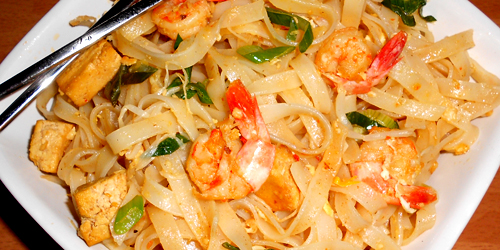
Pad Thai – fried noodles

Ingredients :

  • 300 g of rice noodles
  • 3 tablespoons of oil
  • 1 tablespoon of minced garlic
  • 1 tablespoon of chopped dried shrimps
  • 1 cup of tofu cut into small pieces (or chicken, shrimp)
  • 2 eggs beaten
  • 3 tablespoon of chopped roasted peanuts
  • 1 cup of bean sprouts
  • 2 lemons
  • thaï chives
    Sauce

  • 3 tablespoons of sugar
  • 3 tablespoons of fish sauce
  • 1 tablespoon of soy sauce
  • 2 tablespoons of tamarind juice

Preparation :

Here is an authentic recipe found in the streets of Bangkok.

Put the rice noodles in warm water 10 to 15 minutes to rehydrate, drain and set aside.

Put oil in wok and fry garlic, the dried shrimp and tofu until the garlic becomes golden brown.

Then add the rice noodles and stir on high heat, cook until noodles are cooked. Reduce heat slightly and add all sauce ingredients : sugar, fish sauce, soy sauce and the concentrated of tamarind . Mix well.

Make a place on the right side of the wok, then add eggs and cook then mixed into the noodles. Add the peanuts then bean sprouts and let them cook 3 minutes, stirring occasionally.

Serve the noodles in plates or bowls and garnish with lime wedges, the thaï chives or cilantro.

Tips : In Thailand, it is served with a piece of fresh banana flower beside.
There are variations with pork, or where the whole preparation is wrapped in the egg, or with what people have in their homes.
The recipe for Pad Thai served in Thai restaurants in Western countries is richer. Shrimp may be substituted with the chicken or chopped peanuts and accented with coriander, tamarind juice, red chili.

Anecdotes : The pad thai (sometimes Thai phad , Thai ผัด ไทย) is a traditional Thai dish of noodles popular and very eaten throughout Thailand. Its name means literally “fried Thai style.” The Pad Thai is one of the most famous dishes, outside the country. He became the national dish of Thailand after the economic recession to hit the country after World War II. To reduce the consumption of rice, the government, led by its Prime Minister Phibunsongkram, launched a campaign for the production of rice noodles, by distributing the recipe throughout the country.

Popiah – spring roll

Ingredients :
For 10 springrolls

For the pancakes:

  • 1 1/2 cups of water
  • 3 eggs
  • salt
  • 1 tablespoon of oil
  • 3/4 cup of flour

Sauce “tim cheong”:

  • a long red chile
  • 1 clove garlic
  • 2 tablespoon of plum sauce
  • 2 tablespoon of hoisin sauce

Stuffing Pan:

  • 2 tablespoon of oil
  • 5 cloves garlic, minced
  • 2 tablespoons of fermented soybean paste (tau cheo)
  • 150 g of pork, diced
  • 500 g of jicama (or sweet peas) cut into julienne strips
  • 2 tablespoon of black soy sauce
  • 5 tablespoons of sugar
  • salt
  • 125 g deveined medium shrimp, cleaned
  • 250 g of firm cooked tofu cut thinly sliced ​​
  • 3 eggs, lightly beaten

Stuffing raw:

  • 8 to 10 leaves of green leaf lettuce, washed and dried
  • 1 cup of bean sprouts, rinsed and dried
  • 1 cup of Julienne cucumber
  • 2 green onions, chopped
  • 1/4 cup of coarsely chopped fresh coriander
  • 1/4 cup of fried shallots
  • 1/2 cup of chopped roasted peanuts
  • a fried of red onions

Preparation :

For the batter : Mix together water, eggs, salt and oil, add flour and mix well and let the dough rest for at least 1 hour.

To cook pancakes : Heat a skillet over medium heat, add 1/4 cup of batter and to spread, place the pan on the heat and cook until the cake comes off the sides.
It should be lightly browned then remove, repeat the operation with the rest of the dough. Stack the pancakes.

Wrap in plastic and keep covered until ready to serve, they can be stored in the refrigerator for 1 or 2 days.

For the sauce : Remove skin of the red chili, then remove the seed and slice. Peel and mince the garlic. Crush the chili, garlic and add the plum sauce and hoisin sauce. Reserve.

To cook the filling : Beat the eggs and cook to make an omelet. Cut into thin slices and set aside.

Use a mortar or a blender, mix garlic, onion and then add the fermented soy paste.
Add oil in a wok and sauté the mixture for 3 minutes to release flavors. Rinse the jicama, cut into julienne strips and add jicama, tofu, garlic, the shrimps and pork, cook for a few minutes.
Add soy sauce and sugar and cook about 15 minutes until the vegetables have made all their water.

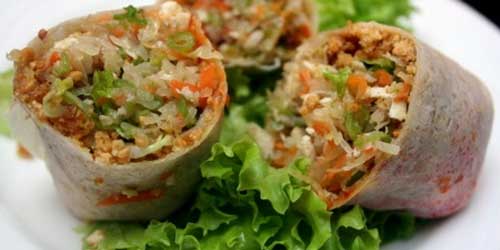
To serve : Place all ingredients in the center of the table. Place the envelopes of popiah near of ingredients. Add a serving of bean sprouts (bangkuang), cilantro, onions, cucumbers, roasted peanuts and scallions, (the guests choose the ingredients according to taste), close the envelope by rolling then dip into the sauce.

Tips: The farce is very diverse in different places. The basic farce is vegetables that grow in the spring with meat and omelet finely cut. In some places, they also add noodles, Chinese sausage, cooked vegetables instead of those bleached, tofu, seafood, sticky rice …

Anecdotes: There are variations in most Asian countries like Indonesia and the Philipinnes is the “Lumpiang Sariwa” or Vietnam is “Bo Bia”. This recipe is found more in China, Taiwan, Singapore and in Malaysia.

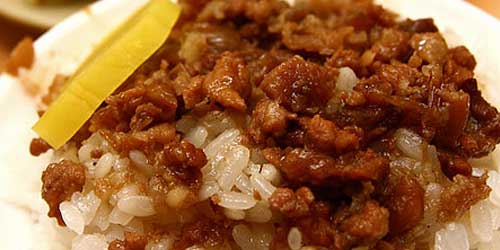
Lu rou fan – braised meat rice

Ingredients :

  • 2 tablespoons of peanut butter
  • 2 anise star or Chinese anise star
  • 6 tablespoons of soy sauce
  • 3 tablespoons of sauce wuxiangfen or 5 spices (powder form)
  • 2 cups of rice
  • 4 cups of water
  • your favorite vegetables (zucchini, carrots, radishes …)
  • 500 g fillet of beef or pork
  • 60 cl of water
  • salt
  • 3 tablespoons of sugar
  • 1 egg

Preparation :

Cut meat into cubes about 2 cm thick.
Brown the meat in a skillet with a little oil over medium heat, once the meatchanges color, add peanut butter and mix.

Pour soy sauce to prepare and add water to the mixture.
Add 3 tablespoons of sugar and sauce wuxiangfen preparation, then pour in the Chinese star anise. Boil all at a high heat. Add soy sauce, water, 3 tablespoons sugar and Wuxiangfen sauce, then add the star anise Chinese, bring to boil on high heat. As soon as mixture begins to boil, turn heat to low and cover.

Using a spoon, remove the foam that formed during cooking of meat and let simmer for 2 hours.

Wash rice well and cook in a rice-cooker with 4 cups of water.

Prepare a hard boiled egg about 20 minutes before the end of cooking the dish. Once it is ready, cut it in half and add it to the preparation’s cooking.

Cook in water the vegetables you would like to eat with your meal. Do not add to the sauce, it will use to garnish your dish.

Place rice on plates, then place your different vegetables around the rice,
Finally, pour the sauce with meat and egg over rice and serve.

Anecdotes : This dish from the north of the island of Taiwan, Lu Rou Fan, you can cooking with meat pork or beef. Popular with Western, this recipe is relatively simple but requires of simmer a period of between 1 to 2 hours

Roti jala – pancakes with coconut milk

Ingredients :

  • 300 g of flour
  • 3 large eggs, lightly beaten
  • 2 teaspoon of corn oil
  • 1 teaspoon of salt
  • 1 tablespoon of ground turmeric
  • 30 cl of water
  • 30 cl of coconut milk

Preparation :

Mix all ingredients until dough is smooth and without lumps, then pass through a sieve.
Heat a nonstick pan over medium-high heat.
Fill the mold with a little dough (there are special mold its a kind of ladle with 5 hole, you can use a bottle pourer).
Make some mini-whirlwinds, in the pan until it forms a large circle (the result give a sort of pancake perforated). Cook 1 minute, then flip and cook the other side for about 30 seconds.

Remove the pancake from the pan, and fold them into triangles or roll them. Repeat the process until you use all the dough.

Serve hot with a curry of your choice.

Anecdotes: These pancakes are very popular during the Muslim fasting month of Ramadan, where vendors set up booths selling temporary. Roti Jala is also very popular as a snack with tea in the afternoon.

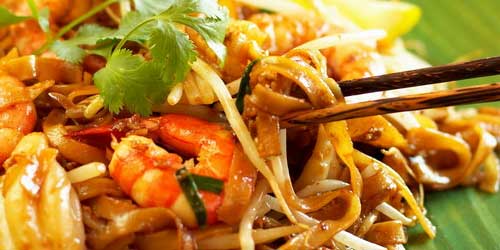
Char kway teow – fried noodles

Ingredients :

  • Oil
  • 2 cloves garlic, minced
  • 1 tablespoon of Sambal oelek (chilli paste)
  • 2 Chinese sausages, sliced ​​
  • 250 g of peeled and deveined shrimp
  • 500 g of fresh rice noodles
  • 1/4 cup of soy sauce
  • 1 tablespoon of brown sugar
  • 2 eggs beaten
  • 1 cup of mung bean sprouts
  • 3 spring onions chopped

Preparation :

Heat oil in a wok on high heat, add garlic and sambal oelek and fry for about 30 seconds. Add the Chinese sausage and shrimp and saute until shrimp are almost cooked.

Reduce heat to medium and add rice noodles then stir and scraping the bottom of the wok to prevent it sticking, then add soy sauce and brown sugar.

Make a hole in the center of the wok, pour in the beaten egg and let cook then mix everything with the noodles.

Add scallions and cook, stirring frequently.

Salt and pepper and serve.

Tips : You can add shallots (with garlic), chicken ground meat, squid, clams, cockles, crab meat or tofu, brussels sprouts, Chinese cabbage shredded, bok choy, spinach and other greens vegetables or germinated seeds. Add 1 or 2 tablespoons oyster sauce instead of sugar if you desired. You can also use dried noodles, in this case rehydrate 20 minutes before use.

Anecdote : Of all versions notable, the style of Penang of char kway teow is the most famous. Its popularity led many sellers out of Penang to call their products “Penang Koay Teow” to attract customers.
In the past, he used to blow the kway teow char in pork fat without eggs (which were however available on request). More recently, ordinary cooking oil is commonly used for religious or health reasons, and eggs have become a standard ingredient in the dish. This very popular dish bears many names, exemple : char kueh teow, char kueh tiao …

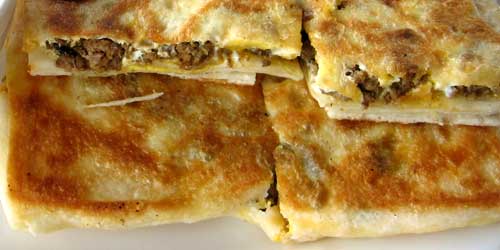
Murtabak – martabak – pancake stuffed

Ingredients :

  • 2 tablespoons of ghee
  • 4 eggs
  • 1 cup of flour
  • 3/4 teaspoon of salt
  • 1/2 teaspoon of freshly ground black pepper
  • 1/4 teaspoon of baking powder
  • 1 glass 1/2 water

Garnish :

  • 600 g of mutton chopped
  • 1 teaspoon of salt
  • 1/4 teaspoon of turmeric powder
  • 8 diced onions
  • 20 cardamoms seeded
  • 2 tablespoons of toasted coriander seeds
  • 1 tablespoon of anise

Preparation :

Fry the turmeric with a little oil and set aside. Cook the lamb and diced onions over low heat and add cardamom, coriander, anise and salt. Reserve.
Mix flour and baking powder in a bowl with a glass and a half of water. Knead into a smooth paste, cover the bowl and let dough rest for the night.

Divide dough into 4 equal portions. Spread it thinly on an oiled marble or a cutting board glass, then add the ghee. Fold and shape into balls then cover the dough with a damp cloth. Let stand 1/2 hour.

Flatten finely the dough into rectangle, place the garnish evenly in the center of the dough, brush over lightly beaten egg over the meat. Wrap the dough over the meat to form a square. Fry in oil until brown on both sides. Serve hot.

Tips : It is often eaten with the curry sauce.

Anecdotes : The Murtabak comes from India, and its trace back to the Sultanate of Delhi (1206-1526). Accompanying the traders, the murtabak aired in many Asian countries of south-west, and remained a popular dish in many of these regions. In Malaysia, it is nicknamed “Mamak” by malaysians. In Indonesia, especially Jakarta, it is called “Martabak”. It comes in two versions, savory and sweet dish. This dish is also eaten in Saudi Arabia and Yemen where it is called “Mutabbaq”.

Pajeon – new onion pancake

Ingredients :

  • 2 onions
  • 80 g of flour
  • 1 dozen oysters
  • 2 eggs
  • 1 red or green chili
  • salt
  • 1/2 glass of water
  • oil

Preparation :

In a bowl put water, salt and flour mix well, then add eggs and mix again.
Wash spring onions and slice 5 cm even the green, then cut the pepper into strips.
Add oysters, new onions and red pepper in the bowl and mix.

Heat a pan and put oil, when it is hot, put a ladleful of the mixture and spread well.Let brown on both sides.
You must use a lot of oil for cooking, so you have the right amount so that the dishis not too fatty.
Mix soy sauce, then sesame oil and sesame seeds.
Serve the pajeon with sauce.

Astuces : We can add the chili powder in the sauce. “Pa” mean spring onion “jeon” mean mixture of egg and flour. There are a large variety of Pajeon : beef, pork, kimchi, shellfish and other seafood are mainly used.

Kimbap – rolled rice and vegetables

Ingredients :

  • 600 g of japanese rice
  • 1 carrot
  • 1 cucumber
  • 2 or 3 sausages Knackis
  • 3 eggs
  • white radish (danmuji) pickled
  • 70 g of Surimi
  • salt
  • Sesame oil
  • Sesame seeds
  • 2-3 nori seaweed

Preparation :

Wash the rice until the water runs clear and drain.

Put the rice in a bowl add salt, sesame oil, sesame seeds and mix. Cook rice in a rice-cooker and when the rice is cooked put to a bowl and let cool.

Cut white radish, cucumber and surimi into strips and reserve.
Cut sausage and carrots into strips and fry in a lightly oiled skillet and set aside. Break the eggs and make an omelet then cut into strips.

Place a nori seaweed on a bamboo special mat for maki and sushi, spread the rice and leave a quarter of the sheet without rice.
The layer of rice will be a little thinner on that side to prevent the Kimbap to have a bump when you roll. Put the vegetables, surimi or Knacki on rice, then roll up.

Refrigerate 1 hour.
Cut into slice and serve with sauce.

Tips: In Korea, there are Kimbap with kimchi, but there are many variations.

Anecdotes: In Korea, we eat often Kimbap when we go to a picnic or snacks.

Japchae – noodles with vegetables

Ingredients :

  • 300 g of soy noodles
  • 200 g of pork (from rib)
  • 1/2 bell pepper
  • 1 carrot
  • 1 onion
  • 60 g of black mushrooms
  • 1 egg

Sauces:

Sauce for the preparation of pork :

  • 2 tablespoons of soy sauce
  • 1 teaspoon of sugar
  • 1 teaspoon of sesame oil
  • 1 teaspoon of spring onions
  • 1 teaspoon of garlic
  • pepper

Chinese vermicelli Sauce :

  • 4 tablespoons of soy sauce
  • 2 teaspoons of sesame oil
  • 2 teaspoons of sugar

Preparation :

Wash and cut into julienne the pepper and carrot and put them in separate bowls and season with salt.
Rehydrate the mushrooms for 20 minutes and drain. Cut the onion into thin slice .
Saute onion and mushrooms over low heat and put them aside.

Cook a fried egg breaking the egg yolk and then cut into strips. Set aside
Cut meat into thin slices, and fry gently to pan with sauce.

Boil water and cook the noodles for 3 minutes, rinse them and cut them in half then put them in a plate.
In same skillet cook the vegetables and season with soy sauce, salt, sesame seeds, sesame oil and a little sugar. Mix.

Put everything in a large plate and add the sliced ​​egg.

Tips : There are many variants of Japchae, is added usually seafood, potatoes and mushrooms.

Anecdotes : The Japchae (noodles with vegetables) is a dish served at parties Korean traditional. Formerly the Japchae was a dish for the king, he still maintains a lot of value in the eyes of Koreans. In our day it is found everywhere on the night market and street vendors, it is eaten in the street sat around small tables in front of the stands of street vendors.