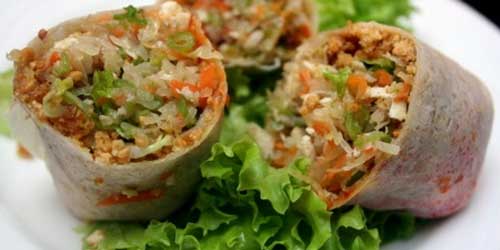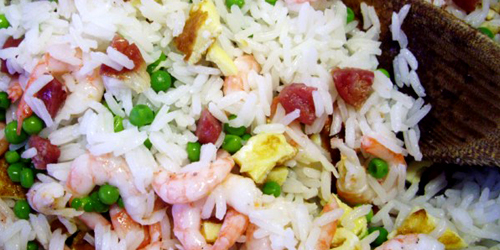
Typical Chinese fried rice

Ingredients :

  • 3 cups of white rice
  • 6 cups of water
  • 10 raw shrimp pink
  • 3 eggs
  • 1 carrot
  • 1 box of peas
  • 1 box of corn
  • 50 g of soy grows
  • 6 sprigs chives
  • 125 g of pork or ready lacquered Chinese sausages 4
  • 2 tablespoon of light soy sauce
  • 1 teaspoon of salt
  • oil

Preparation :

Wash 3 to 4 times the rice and cook in a rice-cooker, for 3 cups of rice put 6 cups of water.

Drain and rinse the corn and the little peas and the growth of soybeans. Chop the stems of chinese chives.

Peel and wash the carrots and cut the small dice.

Cut small dice of the pork lacquered, if you take the Chinese sausage cooked before around 15 minutes in boiling water, dry thoroughly and cut into small dice. Set aside.

Shell the shrimp and made ​​a small cut on the back of the shrimp and remove the black vein.

Break eggs and beat them to make an omelet.

Heat wok over high heat, put oil then pour the egg and well spread for much faster cooking, then cut it into pieces and place in a plate and set aside.

Add a little oil in the wok and add the shrimp and saute until they change color, then add carrots, peas, corn, lacquered pork or Chinese sausages and finally growth of soybean. Let cook 2 to 3 minutes, stirring occasionally.

Add rice, pieces of omelette, the chives and soy sauce and stir so that all is well blended and season with salt.

Tips : For the fried rice you can use cooked rice let from yesterday, and various ingredients such as chicken, beef or duck, mushrooms, onions.

Anecdotes : The cantonese rice is called fried rice in China, it is a very popular dish in the Chinese world, as it is tasty and nutritious and can be economic or refined depending on the choice of ingredients.
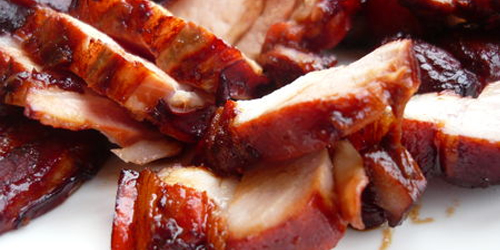
Char sui pork – glazed pork

Ingredients :

  • 400 g of boneless pork loin
  • 3 cloves garlic
  • 1 tablespoon of cooking oil
  • Char Sui Sauce
  • 2 tablespoons of maltose syrup or liquid honey
  • 2 tablespoons of hoisin sauce
  • 1 tablespoon of light soy sauce
  • 1 teaspoon of Kuei Lu Chiew Mei (Chinese liquor)
  • 1 teaspoon of 5 spice
  • 1 teaspoon of sesame oil
  • 3 teaspoon of red dye
  • ½ teaspoon of baking soda
  • 1 teaspoon of glutamate

Preparation :

Cut the pork into medium size pieces .

In a bowl put the soy sauce, the red dye, honey or maltose, five spice, hoisin sauce, sesame oil, and alcohol.

Pour 2/3 of the sauce then add Char Sui sauce, glutamate, baking soda, oil and crushed garlic cloves. Marinate 24 hours in the fridge.

Brush over with remaining sauce and cook meat to 230 ° C for 20 minutes, and watch carefully the pieces of loin and turn occasionally, until caramelized the pieces.

Serve with white rice and a spicy sauce or the hoisin sauce according to your preference.

Tips : you can cook char sui pork on the barbecue, but cut the pieces of pork loin a little bigger.
Char sui pork is eaten as Peking duck, with white rice (char sui fan) or inside the white bun (char sui bau) or in the cantonese rice or with noodles (char sui mein)

Khao Tom – Rice Soup

Ingredients :

  • 1 cup of sticky rice
  • 1 cup of ground pork (or chicken, shrimp,)
  • 50 cl of meat broth
  • salt, pepper
  • minced garlic
  • fresh cilantro

Preparation :

Put the broth in a saucepan with the rice. Bring to a boil.

Add ground pork or other meat (if using seafood, do not cook till the end), stir well to break the meat into small pieces.

Simmer for about 30 minutes until rice starts to become pasty and season to taste with salt and pepper.

Sprinkle chopped garlic and cilantro, then serve.

Tips : If you cook seafood too long, they become dry. The Khao Tom is often taken at breakfast along with an egg and condiments such as chilli and rice vinegar.

Cha gio – nem – pork rolls with crab

Ingredients :
For 24 nems

  • 1/2 cup of soy vermicelli
  • 1 small onion, finely chopped
  • 6 spring onions, finely chopped
  • 250g of minced pork or sausage
  • 185 g of crab meat
  • 1/2 teaspoon of salt
  • 1 teaspoon of fish sauce
  • 1 1/4 teaspoon of ground black pepper
  • 1/2 packet of puff pastry for spring rolls or rice
  • cooking oil
  • salad leaves
  • Fresh mint leaves
  • fresh coriander leaves
  • half cucumber slices

Preparation :

Soak some vermicelli for 10 minutes in hot water, drain and cut into 2.5 cm, with a knife.

Place in bowl with onion, spring onion, pork, crab, salt, the fish sauce and pepper. Mix well.

Place the sheets of rice dough on a damp cloth. When each sheet is softened, cut into 4 pieces. Put amidst 2 teaspoons of farce.

Fold the ends toward the center and roll it so that the farce is completely trapped. Put some water on the edges so that it does not open.

When all the rolls are ready, heat oil in a wok or deep fryer and fry until they become golden. Then drain on paper towels.

Wrap each roll in a lettuce leaf with some mint and cilantro and a slice of cucumber. Serve with rice and the nuoc cham sauce.

Tips: There are many variations of traditional spring rolls, according to farce that can be used with pork, chicken, crab and shrimp. The farce of the Imperial vietnamese recipe is only seasoned with the pepper and salt, without adding soy sauce or fish sauce or spices. It includes bean sprouts and no added herbs or aromatic plant. The farce of nem is exclusively wrapped with the rice cake. Please note that the farce should never contain oyster sauce, or bamboo shoots, or ginger or curry powder or spice or mint leaves chopped or potato, and even less soy sauce. In any case, the farce not should be cooked before rolling in the rice cake! The farce is cooked during the frying of the roll.

Anecdotes : The Nem or Cha Gio is a traditional festive dishes of Vietnam. Very popular in the ancient imperial court of Vietnam, this dish is commonly known as Pâté Imperial, Imperial roll or nem in France or Spring roll and Vietnamese Spring Roll in Anglo-Saxon. Called Nem Ran in northern Vietnam, and Cha Gio in the south, where the name “nem” instead refers to pieces of pork into squares fermented (nem chua) or a skewer of pork meatballs, baked barbecue (nem nuong).

Banh cuon – steamed stuffed rolls

Ingredients :
stuffing:

  • 400 g of lean bacon, chopped
  • 5 shallots, finely chopped
  • 100 g of dried black mushrooms (soak in hot water and finely chopped)
  • 150 g of white radish cut into small dice
  • pepper, salt
  • sugar
  • oil
  • nuoc mam
  • glutamate

pancakes:

  • 150 g of rice flour
  • 75 ml of water

coaching:

  • Coriander
  • soy germ (passed in boiling water)

The sauce:

  • 1 clove garlic, finely chopped
  • 1 red chili chopped
  • 2 tablespoons of nuoc mam
  • 1 teaspoon of sugar
  • 3 teaspoons of vinegar
  • 18 cl of water

Preparation :

Soak black mushrooms in a bowl of hot water for 30 minutes, drain and cut into small pieces.

Cook shallots and set a little aside, then add the garlic, the radishes , pork, the black mushrooms, salt, pepper and a little bit of glutamate.

Mix 150 g of rice flour, 75 ml of water and a pinch of salt and mix until the dough is smooth.

Cook the pancakes as thinly as possible in a pan with a little oil .

Place the pancake on a plate, place 1 tablespoon of farce in the center gently roll it to make a small roll.

When all the rolls are made, cook in a steamer on the paper baking for 20 minutes, then sprinkle with fried shallots .

Make the sauce : Mix 2 tablespoons of nuoc mam, water, sugar, vinegar, garlic and chili.

Serve with the sauce, cilantro and bean sprouts.

Anecdotes : In Vietnamese culture, this dish is often eaten when changing moon. That is to say the full moon and new moon, this dish is often asked for breakfast and lunch.

Banh Chung – glutinous rice cake with pork

Ingredients :

  • 500 g of glutinous rice
  • 200 g of peeled mung beans
  • 450 g of pork loin
  • 1/2 tablespoon of sugar
  • salt, pepperMaterial:
    • a rectangular dish
    • banana leaves or parchment paper or aluminum
    • of kitchen twine
    • a pressure cooker or a rice cooker

    Preparation :

    The night before, soak in a bowl of cold water mung beans, wash the rice and soak in another bowl of cold water and leave to rise overnight.

    Drain the rice and mung beans and mash the beans and reserve.

    Prepare the stuffing in the pork: Cut the meat into cubes, place in a bowl and season with salt, pepper and sugar. Mixing, film and reserve.

    Cut long pieces of twine and have them on the bottom of your dish, crossing them. They used to pack the banh chung.

    Line the dish with aluminum foil or banana.
    Depositing a layer of uncooked rice, about 1 cm in the dish, pressing down well, recover the rice with a thin layer of mashed mung beans settle well with a spoon,place a layer of meat and pack it well, then another layer of beans and rice.

    Fold the edges of the paper toward the center, as a gift to wrap, close with the twine, tight. Gently plunge the banh chung in a pressure cooker or large pot of simmering water and cook 5 hours on low heat, ensure that water is always the same.

    Cool completely  your banh chung before eating and serve in slices or pieces.

    Tips : The Banh Chung is traditionally eaten during the Lunar New Year (Tet), served with pickled onions, pickled vegetables “dua món” and Vietnamese bologna.

    Anecdotes : Traditionally, every home should have at least one pair of Banh chung to put on the family altar. Before Tet, families often offer Banh chung to other families, and it is typical for a vietnamese family to end up with significant amounts of Banh chung long after the party. We distinguish the Banh chung (square) and Bánh Tét, cylindrical (fertility symbol).
    According to an ancient legend, the Banh chung was invented by Lang Lieu (or Tiet Lieu), winner of a competition organized by his father, King Hung Vuong VI the prince who offers the best dish will be the next king. Lang Lieu went up on the throne because the Banh chung, whose form symbolized the Earth (once thought to be square) containing rice (staple food), mung beans (symbolizing the plant) and meat (symbolizing animals or humans); more, “Bánh day” (a variant of the dish) symbolizes the sky. As the dish was meant very symbolic, succeeding generations have continued to follow this tradition and offer Banh chung and Bánh Day at the time of Tết.

Nuoc leo – peanut sauce

Ingredients :

  • 250 g of ground pork
  • 4 cloves garlic
  • 1 tablespoon of oil
  • 4 cups of water
  • 1/2 teaspoon ground black pepper
  • 3 tablespoon of bean sauce
  • 2 cups of chicken stock or pork
  • 2 teaspoon of sugar
  • 1 tablespoon of fish sauce
  • 2 teaspoons hot pepper sauce
  • 1 cup of roasted peanuts

Preparation :

Crush the garlic with a little sugar. Heat oil in a wok and saute garlic over low heat until it begins to change color.

Add pork and fry over medium heat, stirring constantly, to pepper, add bean sauce and stir until meat is done.
Add broth, remaining sugar and fish sauce, mix and simmer another 5 minutes.
Remove from heat.

Place in a blender or mortar the roasted peanuts.

Add chili sauce and peanuts (reserve a few crushed peanuts for garnish).

Sprinkle with peanuts and serve warm or lukewarm.

Canh cu sen – Soup pork and lotus root

Ingredients :

  • 500 g of lean pork ribs
  • 500 g of lotus root
  • 3 spring onions
  • salt
  • 6 cups of water
  • 2 tablespoons of fish sauce

Preparation :

Cut the ribs into small squares.
Peel the lotus root thinly and cut into slices.
Chop the spring onions, including green part.
Simmer all ingredients in a saucepan with water and salt, half an hour until the meat is cooked and the liquid reduced to a third. Add the fish sauce. Serve with rice.

Khao Poun – broth with coconut milk


Ingredients :

  • 1 box of coconut milk
  • 1 tablespoons of red curry paste
  • 1-2 tablespoons of fish sauce
  • Salt
  • 2 pinches of glutamate
  • 2 tablespoons of cooking oil
  • 200 g of minced pork
  • 2 cups of water
  • 1 lemon
  • 5 slices of galangal
  • 5 lemon leaves
  • 200 g of rice noodles
  • Coriander
  • Mint
  • Basil
  • soybean sprouts
  • Banana flower
  • 3 lettuce leaves
  • 1 lemon

Preparation :

Wash the coriander, mint leaves, basil, bean sprouts, lettuce leaves and banana flower.
Chop lettuce and banana flower. Cut lemon into 4. Wash and cut into slices of about 3 cm lemongrass. Peel and wash the galangal and cut into slices. Reserved all.

Plunge the noodles into a pot of boiling water, stir until the noodles soften and remove from heat, drain and set aside.

In a saucepan, bring the red curry paste with 2 tablespoons of oil, stir 5 minutes,then add the coconut milk and stir.

Add ground pork and pour 2 mugs of water, add the galangal, lemongrass andlime leaves and stir. Season with salt, glutamate and nuoc mam sauce and simmer 45 minutes over low heat.

Serve the rice noodles in a large bowl, add the vegetables and then sprinkle withthe hot broth.

Tips : You can add to vegetables the green beans, grated carrot.

Anecdotes: The Khao Poun is an indispensable dish at a wedding Lao.

Popiah – spring roll

Ingredients :
For 10 springrolls

For the pancakes:

  • 1 1/2 cups of water
  • 3 eggs
  • salt
  • 1 tablespoon of oil
  • 3/4 cup of flour

Sauce “tim cheong”:

  • a long red chile
  • 1 clove garlic
  • 2 tablespoon of plum sauce
  • 2 tablespoon of hoisin sauce

Stuffing Pan:

  • 2 tablespoon of oil
  • 5 cloves garlic, minced
  • 2 tablespoons of fermented soybean paste (tau cheo)
  • 150 g of pork, diced
  • 500 g of jicama (or sweet peas) cut into julienne strips
  • 2 tablespoon of black soy sauce
  • 5 tablespoons of sugar
  • salt
  • 125 g deveined medium shrimp, cleaned
  • 250 g of firm cooked tofu cut thinly sliced ​​
  • 3 eggs, lightly beaten

Stuffing raw:

  • 8 to 10 leaves of green leaf lettuce, washed and dried
  • 1 cup of bean sprouts, rinsed and dried
  • 1 cup of Julienne cucumber
  • 2 green onions, chopped
  • 1/4 cup of coarsely chopped fresh coriander
  • 1/4 cup of fried shallots
  • 1/2 cup of chopped roasted peanuts
  • a fried of red onions

Preparation :

For the batter : Mix together water, eggs, salt and oil, add flour and mix well and let the dough rest for at least 1 hour.

To cook pancakes : Heat a skillet over medium heat, add 1/4 cup of batter and to spread, place the pan on the heat and cook until the cake comes off the sides.
It should be lightly browned then remove, repeat the operation with the rest of the dough. Stack the pancakes.

Wrap in plastic and keep covered until ready to serve, they can be stored in the refrigerator for 1 or 2 days.

For the sauce : Remove skin of the red chili, then remove the seed and slice. Peel and mince the garlic. Crush the chili, garlic and add the plum sauce and hoisin sauce. Reserve.

To cook the filling : Beat the eggs and cook to make an omelet. Cut into thin slices and set aside.

Use a mortar or a blender, mix garlic, onion and then add the fermented soy paste.
Add oil in a wok and sauté the mixture for 3 minutes to release flavors. Rinse the jicama, cut into julienne strips and add jicama, tofu, garlic, the shrimps and pork, cook for a few minutes.
Add soy sauce and sugar and cook about 15 minutes until the vegetables have made all their water.

To serve : Place all ingredients in the center of the table. Place the envelopes of popiah near of ingredients. Add a serving of bean sprouts (bangkuang), cilantro, onions, cucumbers, roasted peanuts and scallions, (the guests choose the ingredients according to taste), close the envelope by rolling then dip into the sauce.

Tips: The farce is very diverse in different places. The basic farce is vegetables that grow in the spring with meat and omelet finely cut. In some places, they also add noodles, Chinese sausage, cooked vegetables instead of those bleached, tofu, seafood, sticky rice …

Anecdotes: There are variations in most Asian countries like Indonesia and the Philipinnes is the “Lumpiang Sariwa” or Vietnam is “Bo Bia”. This recipe is found more in China, Taiwan, Singapore and in Malaysia.

Ba wan – meat ball

Ingredients :

about 15 meatballs

For the skin:

  • 1 cup of rice flour
  • 400 g of yam flour
  • 6 1/5 cup of cold water

For the filling:

  • 400 g of minced pork
  • 8 dried shiitake mushrooms
  • 170 g dried bamboo shoots
  • 2 tablespoon of dried shrimp
  • 1 tablespoon of fried onion
  • 2 tablespoons of oil
  • 4 cloves garlic, minced

Marinades for pork:

  • 1 1/2 tablespoon of soy sauce
  • 1 teaspoon of sugar
  • 1/4 teaspoon of powder pepper
  • 1 tablespoon of cornstarch

Seasonings:

  • 1 tablespoons of cooking wine
  • 1 tablespoon of soy sauce
  • 1/2 teaspoon of salt
  • 1/4 teaspoon of 5 spice

For the sauce:

    • 2 tablespoons of rice flour
    • 1 1/2 cups of water
    • 1 tablespoon of sugar
    • 1 tablespoon of Miso
    • 2 tablespoons of tomato ketchup

Preparation :
Mix rice flour and cold water in a saucepan. Whisk until all the rice flour is dissolved in water. Cook mixture over medium heat, stirring constantly until it begins to boil and thicken like glue. It takes about 30 minutes. Remove from heat and let cool and set aside.

To prepare the toppings. Marinate the ground pork with soy sauce, sugar, pepper and cornstarch for 2 hours.

Soak the dried mushrooms until wilted and dried bamboo shoots for 20 minutes, then blanch in boiling water. Soak the dried shrimp for 20 minutes.

Heat a pan with 2 tablespoons oil, add garlic, dried shrimp and mushrooms and saute 1 minute. Add the marinated pork and cook until pork is no longer pink. Add bamboo shoots and stir fry for 1 minute. Season with cooking wine, soy sauce, 5 spice, fried onions and salt. Stir and remove from heat and set aside.

Prepare small bowls and grease with a little oil. Sift flour yam. Add yam flour sifted into the mixture of glutinous rice that had cooled a little bit.
Initially, the texture has a rough appearance. Continue to mix until a smooth paste. Fill greased bowl with 2-3 tablespoons of mixture and spread it in the bowl.

fill to the brim , cover filling with the rice mixture and ensure that all the filling is covered. Repeat until all mixture is used.

Bring a saucepan of water to a boil. Place the bowls in a steamer basket and cook for 15 minutes.

Meanwhile, prepare sauce by mixing in a small pan, the rice flour, water, sugar, miso and ketchup. Cook over medium heat, stirring constantly, until a thick and sticky. The sauce will thicken.

When the cooking is complete, remove from heat and let cool for several minutes until dough is firmer.
Use a butter knife to unmold the meatball then use scissors to make an x by cutting above meatball.
Drizzle with sauce and sprinkle with chopped parsley and serve.

Tips : The stuffing varies in different regions of Taiwan. It can also be fried after have unmold the meatball.

Anecdotes: It is believed that ba-wan was first prepared in Beidou Township of Taiwan by a student named Fan Wànjū. She served as food for disaster relief from heavy flooding during the late Qing Dynasty (1644-1912). Since then, ba-wan has spread in different regions of Taiwan and is now considered by many as a national food.

Mapo Tofu – Mapo doufu – Ground pork with Tofu

Ingredients :

  • 100 g of minced pork belly
  • 20 g of pickled vegetables
  • 200 g of tofu
  • 1 teaspoon of starch potato
  • 1 tablespoon of water
  • 4 tablespoon of oil
  • 3 cloves garlic
  • 1 tablespoon of chili bean paste
  • 2 teaspoon of light soy sauce
  • 1 teaspoon of dark soy sauce
  • sugar
  • 15 cl of chicken broth
  • 1 teaspoon of chili oil
  • 2 teaspoons of sesame oil
  • ½  teaspoon of ground pepper
  • 3 chives
  • salt
  • 1 ½  teaspoon of wine or sherry Shaohxing

Preparation :

Drain tofu and vegetables in brine rinse and dry. Chop the vegetables and cut the tofu into 1 cm cubes. Reserve.
Peel 2 garlic and chop finely.

Mix in a bowl, 1/8 teaspoon of salt, ¼ teaspoon of sugar, 1 teaspoon of light soy sauce, 1 teaspoon of dark soy sauce, 1 ½ teaspoon of wine or sherry Shaohxing, 1 teaspoon of sesame oil. Then add the meat and marinate 30 minutes.

Mix water and cornstarch potato in a bowl.
Heat up the wok over high heat and add oil, saute the meat and garlic. Then, add pickled vegetables, soybean paste, soy sauce and sugar, continuing to mix sowell into the meat.
Pour the broth and slowly bring to a boil over medium heat, add the tofu and mix carefully to avoid crushing it. Cook about two minutes so it absorbs the flavors ofthe meat and sauce.

Stir water and cornstarch, add the chili oil, sesame oil, Sichuan pepper and onions. Serve hot with rice.

Anecdotes: Mapo doufu can also be found in China, Korea, Japan and Taiwan, where the flavor is adapted to local tastes. In Japan, where the dish is called mabo tofu, was introduced by Chen Kenmin who opened the first restaurant of Sichuan in Tokyo in the 1950s. Instead of using only bean paste salty and spicy, Chen has also adopted the sweet bean paste in the recipe and make it less spicy and less greasy. In Hong Kong and Taiwan, similar variations can also be found.