Bobor sach moan – chicken soup

Ingredients :

  • 2 cup of rice
  • 1 chicken
  • 2  onion
  • 2 cube of chicken broth
  • 1 tablespoon of coriander seeds
  • 1 tablespoon of whole peppercorns
  • 1 tablespoon of sugar
  • 1 teaspoon of salt
  • 1 teaspoon of fried garlic
  • 3 cloves of garlic
  • 2 L of Water
  • 50 g of thaï coriander
  • 1 green onion
  • 1/2 ginger

Preparation :

In a saucepan put 2 liters of water then add onion, crushed garlic, chicken, ginger, chicken broth cubes, sugar, salt, coriander seeds and pepper. Add more water if necessary to cover the chicken.

Cook for about 50 minutes over high heat and remove chicken. To check if the chicken is cooked prick with a fork and if the blood does not flow it is cooked, if not cook a little longer if you are unsure.

Wash the rice until the water runs clear and reserved.

Remove chicken and let cool, add the rice in the broth then heat over medium heat and simmer until rice is cooked.

When the chicken has cooled, remove meat, crumble into pieces with your hands, then put them back in broth. Simmer 10 minutes over high heat.

Serve in a bowl, season with chopped coriander, green onion and fried garlic and then served hot.

Tips : You can add dried shrimp or salted soy beans or chili paste if you like spicy food.

Anecdotes : The Cambodian Bobor is a dish best served on breakfast or at lunch depending on your preferences.

Pittu – coconut round

Ingredients :

  • 2 cups of shredded coconut fresh or dry
  • 1 cup of rice flour
  • 1 cup of fine semolina
  • 1 1/2 teaspoon of salt

Preparation :

If using the dried coconut, place in large bowl and pour a glass of water for rehydrate. The fresh coconut does not need water.

Put the coconut in a bowl and add the sifted flour, semolina and salt.
Work by hand as a pastry. The mixture should resemble breadcrumbs.

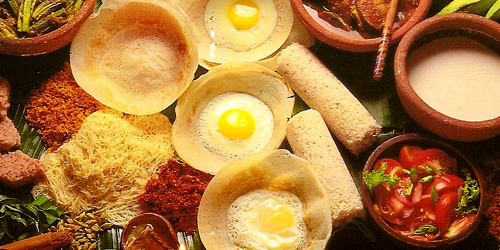
Fill in the bamboo tube or in a special tube (see photo) and lightly pressed down, you can use a thin tin can that you have pierced the bottom.

cook 15 minutes in a steamer basket. Let cool before unmolding.

Serve with coconut milk, the lunu miris Sambol or strong curry like curry tripe who is traditionally serve with the pittu.

Anecdotes : The pittu was probably introduced at Sri Lanka by Malaysian regiments of the colonial period. However, it was completely “naturalized” and is now a staple food of Sri Lankans.

Lunu miris – spicy sambal

Ingredients :

  • 2 medium onions chopped
  • 4 tablespoons of fish to the Maldives
  • 2 tablespoons of dry red chili
  • 1 teaspoon of chili powder
  • 2 tablespoons of lemon juice
  • salt

Preparation :

Mix salt, red chili and chili powder in a mortar, then add the fish from Maldives chopped into small pieces then add the onions in the mortar and crush until a fine paste.

Place in a bowl and add lemon juice, salt and mix.

You can serve with rice, the chutney, sambal, hoppers …

Tips : You can replace the onions with shallots and fish for shrimp by maldives.

Hoppers – appa – pancakes with coconut milk

Ingredients :

  • 15 g of fresh yeast or 1 teaspoon in baking powder
  • 1/2 cup of warm water
  • 1 1/2 teaspoon of sugar
  • 1/2 cup of ground rice
  • 1/2 cup of rice flour
  • 1 teaspoon of salt
  • 70cl of coconut milk

Preparation :

Crumble the yeast in ½ cup warm water, stir well to dissolve, add sugar and let stand 10 minutes.
In a bowl, mix the ground rice, flour and salt.
Add the yeast dissolved in coconut cream and pour into the bowl where the flour and ground rice.
Mix to a paste not too thick and smooth, like a pancake batter.
Let stand overnight or place during the hours in an oven off but still warm.
It should double in volume.
When you pour the batter into the pan, that is rotated, it must cover the walls with a thin almost transparent. If it is not fluid enough, add some coconut milk.
Heat the pan over low heat and lightly oil.
Pour a small ladleful of batter.
Immediately lift the pan by its two handles and rotate so that was lining the dough into 2/3 of the height. Cover. Cook 5 minutes over low heat.
Discover. When the edges of the crepe begin to take a slightly golden.
In the center of the pancake, there is a small circle of slightly spongy texture, while the curved edges are thin and crisp as a wafer.
Remove the hopper from the pan using a metal spatula.
Serve hot with Sambol hoppers or curries of meat, fish or chicken.

Anecdotes : cooking was done by pressing the stove hoppers in charcoal, so as to evenly distribute the heat source. You can get a special stove hopper in specialty stores.

Seeni Sambol – sambal with onion

Ingredients :

  • 1 kg of onions
  • 50 g of sugar
  • 8 cardamom pods
  • 2 cinnamon sticks
  • 4 cloves garlic
  • 1 tablespoon of chili powder
  • 3 tablespoons of concentrated of tamarind
  • 6 leaves of caloupilé
  • 5 cm of leaves of pandanus (rampe)
  • 50 g of ghee
  • Salt

Preparation :

Mince the onions finely and grind the cardamom seeds.

Heat oil in skillet, saute the onions, cardamom, cinnamon, cloves, the leaves of pandanus and caloupilé, with a pinch of salt.

When the onions are golden brown, empty the biggest party of the oil to leave only the equivalent of a teaspoon.

Add chili powder and the concentrated of tamarind, mix well. Saute for 5 minutes over high heat, until mixture is deep brown and the liquid has evaporated.

Add sugar and mix well and immediately remove from fire without caramelize.
Let cool and refrigerate.

It is consumed warm or cold as an accompaniment to many dishes.

Tips : If you do not have a “rampe” pronounced “rampé”, you can replace it with a bunch of chives … but the taste will be different of course.

Pol Sambal – Coconut Sambal

Ingredients :

  • 2 cups of fresh coconut or desiccated
  • 2 small onions or shallots
  • ​​1 green chili
  • 1 clove garlic
  • 1 tablespoon of chopped red chili
  • Salt
  • 1 lime juice

Preparation :

If using dry coconut rehydrate with 1/4 of warm water.

Cut into chunks and chop in a blender or mortar the onions or shallots, the green chili, the garlic and mix them in a bowl.

Add coconut and mix, then add the red chili and the lime juice, salt and pepper.

Let marinate at least 2 hours in refrigerator.

Serve with rice and curry.

Tips : You can use a coconut as you empty yourself, but the work can be long if you have not used.

Anecdotes : Pol means coconut in Sinhalese.

Papad – papadam – lentils pancake

Ingredients :
For 30 papads

  • 8 cups of flour lens
  • 25 ml of water
  • 1 teaspoon of cumin seeds
  • 1 teaspoon of salt
  • 1 teaspoon of black pepper
  • A little oil

Preparation :

In a bowl, combine flour lens, salt, pepper and cumin seeds.

Make a well in center, add water and knead until dough is smooth.
Cut dough into balls.

On a surface lightly oiled and floured, flatten the balls in very thin pancake with a roller.

Place baking paper on a baking sheet sprinkled with flour to prevent the pancakes from sticking.

Bake in oven one hour at 100 °, let cool.

This should look like a sort of pancake crisp and dry.

Serve as an aperitif or to accompany a dish.

Tips : Serve with small bowls of sauce and red chilis finely chopped and can be eaten with various toppings such as chopped onions, chutney or dips and other condiments. In parts of India, it is served as the final element of a meal.

Anecdotes : We find the papadam in worldwide under various names : Appalam, Popodum, Poppodum, Papadamo, Papad, Papadam, Papari.

Khao Tom – Rice Soup

Ingredients :

  • 1 cup of sticky rice
  • 1 cup of ground pork (or chicken, shrimp,)
  • 50 cl of meat broth
  • salt, pepper
  • minced garlic
  • fresh cilantro

Preparation :

Put the broth in a saucepan with the rice. Bring to a boil.

Add ground pork or other meat (if using seafood, do not cook till the end), stir well to break the meat into small pieces.

Simmer for about 30 minutes until rice starts to become pasty and season to taste with salt and pepper.

Sprinkle chopped garlic and cilantro, then serve.

Tips : If you cook seafood too long, they become dry. The Khao Tom is often taken at breakfast along with an egg and condiments such as chilli and rice vinegar.

Pad Thai – fried noodles

Ingredients :

  • 300 g of rice noodles
  • 3 tablespoons of oil
  • 1 tablespoon of minced garlic
  • 1 tablespoon of chopped dried shrimps
  • 1 cup of tofu cut into small pieces (or chicken, shrimp)
  • 2 eggs beaten
  • 3 tablespoon of chopped roasted peanuts
  • 1 cup of bean sprouts
  • 2 lemons
  • thaï chives
    Sauce

  • 3 tablespoons of sugar
  • 3 tablespoons of fish sauce
  • 1 tablespoon of soy sauce
  • 2 tablespoons of tamarind juice

Preparation :

Here is an authentic recipe found in the streets of Bangkok.

Put the rice noodles in warm water 10 to 15 minutes to rehydrate, drain and set aside.

Put oil in wok and fry garlic, the dried shrimp and tofu until the garlic becomes golden brown.

Then add the rice noodles and stir on high heat, cook until noodles are cooked. Reduce heat slightly and add all sauce ingredients : sugar, fish sauce, soy sauce and the concentrated of tamarind . Mix well.

Make a place on the right side of the wok, then add eggs and cook then mixed into the noodles. Add the peanuts then bean sprouts and let them cook 3 minutes, stirring occasionally.

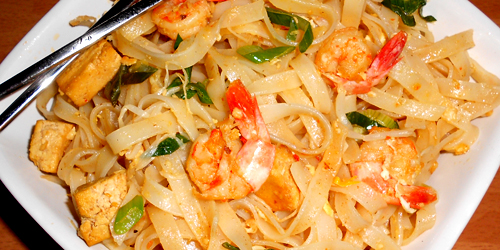
Serve the noodles in plates or bowls and garnish with lime wedges, the thaï chives or cilantro.

Tips : In Thailand, it is served with a piece of fresh banana flower beside.
There are variations with pork, or where the whole preparation is wrapped in the egg, or with what people have in their homes.
The recipe for Pad Thai served in Thai restaurants in Western countries is richer. Shrimp may be substituted with the chicken or chopped peanuts and accented with coriander, tamarind juice, red chili.

Anecdotes : The pad thai (sometimes Thai phad , Thai ผัด ไทย) is a traditional Thai dish of noodles popular and very eaten throughout Thailand. Its name means literally “fried Thai style.” The Pad Thai is one of the most famous dishes, outside the country. He became the national dish of Thailand after the economic recession to hit the country after World War II. To reduce the consumption of rice, the government, led by its Prime Minister Phibunsongkram, launched a campaign for the production of rice noodles, by distributing the recipe throughout the country.

Cha gio – nem – pork rolls with crab

Ingredients :
For 24 nems

  • 1/2 cup of soy vermicelli
  • 1 small onion, finely chopped
  • 6 spring onions, finely chopped
  • 250g of minced pork or sausage
  • 185 g of crab meat
  • 1/2 teaspoon of salt
  • 1 teaspoon of fish sauce
  • 1 1/4 teaspoon of ground black pepper
  • 1/2 packet of puff pastry for spring rolls or rice
  • cooking oil
  • salad leaves
  • Fresh mint leaves
  • fresh coriander leaves
  • half cucumber slices

Preparation :

Soak some vermicelli for 10 minutes in hot water, drain and cut into 2.5 cm, with a knife.

Place in bowl with onion, spring onion, pork, crab, salt, the fish sauce and pepper. Mix well.

Place the sheets of rice dough on a damp cloth. When each sheet is softened, cut into 4 pieces. Put amidst 2 teaspoons of farce.

Fold the ends toward the center and roll it so that the farce is completely trapped. Put some water on the edges so that it does not open.

When all the rolls are ready, heat oil in a wok or deep fryer and fry until they become golden. Then drain on paper towels.

Wrap each roll in a lettuce leaf with some mint and cilantro and a slice of cucumber. Serve with rice and the nuoc cham sauce.

Tips: There are many variations of traditional spring rolls, according to farce that can be used with pork, chicken, crab and shrimp. The farce of the Imperial vietnamese recipe is only seasoned with the pepper and salt, without adding soy sauce or fish sauce or spices. It includes bean sprouts and no added herbs or aromatic plant. The farce of nem is exclusively wrapped with the rice cake. Please note that the farce should never contain oyster sauce, or bamboo shoots, or ginger or curry powder or spice or mint leaves chopped or potato, and even less soy sauce. In any case, the farce not should be cooked before rolling in the rice cake! The farce is cooked during the frying of the roll.

Anecdotes : The Nem or Cha Gio is a traditional festive dishes of Vietnam. Very popular in the ancient imperial court of Vietnam, this dish is commonly known as Pâté Imperial, Imperial roll or nem in France or Spring roll and Vietnamese Spring Roll in Anglo-Saxon. Called Nem Ran in northern Vietnam, and Cha Gio in the south, where the name “nem” instead refers to pieces of pork into squares fermented (nem chua) or a skewer of pork meatballs, baked barbecue (nem nuong).

Banh cuon – steamed stuffed rolls

Ingredients :
stuffing:

  • 400 g of lean bacon, chopped
  • 5 shallots, finely chopped
  • 100 g of dried black mushrooms (soak in hot water and finely chopped)
  • 150 g of white radish cut into small dice
  • pepper, salt
  • sugar
  • oil
  • nuoc mam
  • glutamate

pancakes:

  • 150 g of rice flour
  • 75 ml of water

coaching:

  • Coriander
  • soy germ (passed in boiling water)

The sauce:

  • 1 clove garlic, finely chopped
  • 1 red chili chopped
  • 2 tablespoons of nuoc mam
  • 1 teaspoon of sugar
  • 3 teaspoons of vinegar
  • 18 cl of water

Preparation :

Soak black mushrooms in a bowl of hot water for 30 minutes, drain and cut into small pieces.

Cook shallots and set a little aside, then add the garlic, the radishes , pork, the black mushrooms, salt, pepper and a little bit of glutamate.

Mix 150 g of rice flour, 75 ml of water and a pinch of salt and mix until the dough is smooth.

Cook the pancakes as thinly as possible in a pan with a little oil .

Place the pancake on a plate, place 1 tablespoon of farce in the center gently roll it to make a small roll.

When all the rolls are made, cook in a steamer on the paper baking for 20 minutes, then sprinkle with fried shallots .

Make the sauce : Mix 2 tablespoons of nuoc mam, water, sugar, vinegar, garlic and chili.

Serve with the sauce, cilantro and bean sprouts.

Anecdotes : In Vietnamese culture, this dish is often eaten when changing moon. That is to say the full moon and new moon, this dish is often asked for breakfast and lunch.

Banh Chung – glutinous rice cake with pork

Ingredients :

  • 500 g of glutinous rice
  • 200 g of peeled mung beans
  • 450 g of pork loin
  • 1/2 tablespoon of sugar
  • salt, pepperMaterial:
    • a rectangular dish
    • banana leaves or parchment paper or aluminum
    • of kitchen twine
    • a pressure cooker or a rice cooker

    Preparation :

    The night before, soak in a bowl of cold water mung beans, wash the rice and soak in another bowl of cold water and leave to rise overnight.

    Drain the rice and mung beans and mash the beans and reserve.

    Prepare the stuffing in the pork: Cut the meat into cubes, place in a bowl and season with salt, pepper and sugar. Mixing, film and reserve.

    Cut long pieces of twine and have them on the bottom of your dish, crossing them. They used to pack the banh chung.

    Line the dish with aluminum foil or banana.
    Depositing a layer of uncooked rice, about 1 cm in the dish, pressing down well, recover the rice with a thin layer of mashed mung beans settle well with a spoon,place a layer of meat and pack it well, then another layer of beans and rice.

    Fold the edges of the paper toward the center, as a gift to wrap, close with the twine, tight. Gently plunge the banh chung in a pressure cooker or large pot of simmering water and cook 5 hours on low heat, ensure that water is always the same.

    Cool completely  your banh chung before eating and serve in slices or pieces.

    Tips : The Banh Chung is traditionally eaten during the Lunar New Year (Tet), served with pickled onions, pickled vegetables “dua món” and Vietnamese bologna.

    Anecdotes : Traditionally, every home should have at least one pair of Banh chung to put on the family altar. Before Tet, families often offer Banh chung to other families, and it is typical for a vietnamese family to end up with significant amounts of Banh chung long after the party. We distinguish the Banh chung (square) and Bánh Tét, cylindrical (fertility symbol).
    According to an ancient legend, the Banh chung was invented by Lang Lieu (or Tiet Lieu), winner of a competition organized by his father, King Hung Vuong VI the prince who offers the best dish will be the next king. Lang Lieu went up on the throne because the Banh chung, whose form symbolized the Earth (once thought to be square) containing rice (staple food), mung beans (symbolizing the plant) and meat (symbolizing animals or humans); more, “Bánh day” (a variant of the dish) symbolizes the sky. As the dish was meant very symbolic, succeeding generations have continued to follow this tradition and offer Banh chung and Bánh Day at the time of Tết.