Kue Mangkok – cupcakes

Ingredients :

  • 350 g of rice flour
  • 150 g of flour
  • 200 g of fermented cassava
  • 400 g of sugar
  • 10 cl of water
  • 20 cl of hot water
  • 25 cl of soda water
  • 2 teaspoons of baking powder
  • 100 g of coconut
  • 1 tablespoon of vanilla
  • Salt
  • coloring of your choice

Preparation :

In a bowl place the flour, rice flour and 10 ounces of water and mix well. Then add the cassava, sugar and mix again.
Add 20 ounces of hot water and knead the dough for about 10 minutes.

Add baking powder, soda water and vanilla, mixing until everything is uniform.Finally, add the food coloring and mix until the consistency is smooth.

Reheat molds of cupcake for about 5 minutes and fill them in 3/3.
Put in a basket of steamer then cook on high heat for about 20 minutes.

The cakes are ready when they open like flowers.
Sprinkle a little grated coconut on top of cake and serve cold.

Anecdotes: Kue Mangkok cake is popular in Indonesia. They are usually sold in markets and have summers brought by immigrants from southern China. We find this cake for birthdays or meetings. This cake is visually appealing, because it is usually brightly colored.
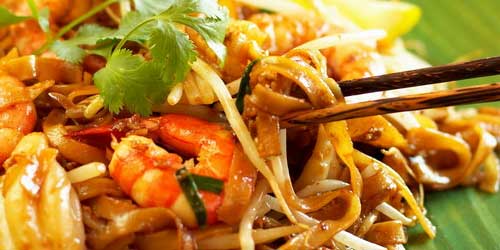
Char kway teow – fried noodles

Ingredients :

  • Oil
  • 2 cloves garlic, minced
  • 1 tablespoon of Sambal oelek (chilli paste)
  • 2 Chinese sausages, sliced ​​
  • 250 g of peeled and deveined shrimp
  • 500 g of fresh rice noodles
  • 1/4 cup of soy sauce
  • 1 tablespoon of brown sugar
  • 2 eggs beaten
  • 1 cup of mung bean sprouts
  • 3 spring onions chopped

Preparation :

Heat oil in a wok on high heat, add garlic and sambal oelek and fry for about 30 seconds. Add the Chinese sausage and shrimp and saute until shrimp are almost cooked.

Reduce heat to medium and add rice noodles then stir and scraping the bottom of the wok to prevent it sticking, then add soy sauce and brown sugar.

Make a hole in the center of the wok, pour in the beaten egg and let cook then mix everything with the noodles.

Add scallions and cook, stirring frequently.

Salt and pepper and serve.

Tips : You can add shallots (with garlic), chicken ground meat, squid, clams, cockles, crab meat or tofu, brussels sprouts, Chinese cabbage shredded, bok choy, spinach and other greens vegetables or germinated seeds. Add 1 or 2 tablespoons oyster sauce instead of sugar if you desired. You can also use dried noodles, in this case rehydrate 20 minutes before use.

Anecdote : Of all versions notable, the style of Penang of char kway teow is the most famous. Its popularity led many sellers out of Penang to call their products “Penang Koay Teow” to attract customers.
In the past, he used to blow the kway teow char in pork fat without eggs (which were however available on request). More recently, ordinary cooking oil is commonly used for religious or health reasons, and eggs have become a standard ingredient in the dish. This very popular dish bears many names, exemple : char kueh teow, char kueh tiao …

Getuk lindri – steam cake coconut

Ingredients :

  • 900 g of cassava
  • 200 g of sugar
  • 1/2 teaspoon vanilla extract
  • 150 g of grated coconut
  • salt
  • 10 cl of water
  • food coloring

Preparation :

Cook in a steamer the cassava, until it is tender then peel and mash in puree smooth. Mix sugar and water in a saucepan and bring to boil.

Pour over the mashed cassava and mix well, then add vanilla extract and food coloring.

Make a smooth paste and cut to your own taste (you can give the shape that you want).

Meanwhile cook the grated coconut steamed until it is hot and soft. Arrange the cakes of cassava on a serving plate. Mix the grated coconut and salt and sprinkle over cake.

Serve.

beef rendang

Ingredients :

  • 1 teaspoon of salt
  • 1 teaspoon of turmeric
  • 1/2 teaspoon of chili powder
  • 6 cloves garlic, minced
  • 5 cm of ginger, peeled and grated
  • 5 cm of fresh galangal, peeled and grated
  • 1 teaspoon of black peppercorns coarsely crushed
  • 4 cardamom pods, crushed
  • 4 red chillies, seeded and chopped
  • 1 stalk lemongrass, finely chopped (just the bulb)
  • 3 large onions, finely chopped
  • 2 tablespoons of tamarind water
  • 3 tablespoon of cooking oil
  • 1 kg of braising beef
  • 80 cl of coconut milk (2 cans)
  • 20 cl of beef broth
  • 1 tablespoon of brown sugar
  • 4 kaffir lime leaves (bergamot) sliced ​​
  • 3 anise star
  • 1 large cinnamon stick

Preparation :

Cook beef in water with the peppercorns, onion and salt. A boil, reduce heat and remove gray scum that forms .
When there is no more foam, let cook covered for 2 hours. Once cooked, cut the beef into cubes and reserve. Strain the stock with a sieve.

Coarsely grind the salt, turmeric, chili powder, garlic, ginger, galangal, peppercorns, cardamom and chili in a blender. You can also use a mortar or pestle. Add the lemongrass and onions, then blend again until dough is dry. Stir in the tamarind water and mix again. The dough should be homogeneous.

Heat oil in a stewpan and pour  the spice paste, fry for 2 to 3 minutes stirring constantly.
Then add the beef with all remaining ingredients and bring slowly to a boil stirring constantly.

Reduce heat, let simmer half covered for 2 hours over very low heat, stirring occasionally. The sauce should reduce and thicken. The taste of all spices should blend harmoniously.

Serve with rice.

Tips : Can be added to the end of the cooking potatoes or small red beans.

Anecdotes : The rendang is a dish originating in  Minangkabau in Indonesia and is now consumed throughout the country, but also in Malaysia and Brunei.

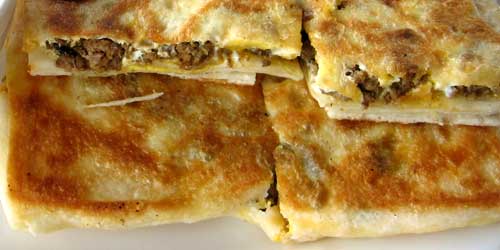
Murtabak – martabak – pancake stuffed

Ingredients :

  • 2 tablespoons of ghee
  • 4 eggs
  • 1 cup of flour
  • 3/4 teaspoon of salt
  • 1/2 teaspoon of freshly ground black pepper
  • 1/4 teaspoon of baking powder
  • 1 glass 1/2 water

Garnish :

  • 600 g of mutton chopped
  • 1 teaspoon of salt
  • 1/4 teaspoon of turmeric powder
  • 8 diced onions
  • 20 cardamoms seeded
  • 2 tablespoons of toasted coriander seeds
  • 1 tablespoon of anise

Preparation :

Fry the turmeric with a little oil and set aside. Cook the lamb and diced onions over low heat and add cardamom, coriander, anise and salt. Reserve.
Mix flour and baking powder in a bowl with a glass and a half of water. Knead into a smooth paste, cover the bowl and let dough rest for the night.

Divide dough into 4 equal portions. Spread it thinly on an oiled marble or a cutting board glass, then add the ghee. Fold and shape into balls then cover the dough with a damp cloth. Let stand 1/2 hour.

Flatten finely the dough into rectangle, place the garnish evenly in the center of the dough, brush over lightly beaten egg over the meat. Wrap the dough over the meat to form a square. Fry in oil until brown on both sides. Serve hot.

Tips : It is often eaten with the curry sauce.

Anecdotes : The Murtabak comes from India, and its trace back to the Sultanate of Delhi (1206-1526). Accompanying the traders, the murtabak aired in many Asian countries of south-west, and remained a popular dish in many of these regions. In Malaysia, it is nicknamed “Mamak” by malaysians. In Indonesia, especially Jakarta, it is called “Martabak”. It comes in two versions, savory and sweet dish. This dish is also eaten in Saudi Arabia and Yemen where it is called “Mutabbaq”.

Phulkopir Paturi – cauliflower mustard

Ingredients :

  • 1 cauliflower cut into small florets
  • 2 potatoes, diced
  • 1 onion diced
  • 1 tomato finely chopped
  • 4 green chillies finely chopped
  • 2 tablespoons of grated coconut
  • 1/2 tablespoon of turmeric,
  • 2 tablespoons of mustard seeds
  • 3 tablespoon of poppy seeds
  • 1 tablespoon of minced garlic
  • 3 cups water
  •  Oil
  • Salt

Preparation :
Blanch the cauliflower pieces and potato for 5 minutes. Drain in a colander and reserve.
Grind the grated coconut with garlic then add the poppy seeds, mustard seeds and turmeric. Then add the chopped onions, tomatoes and chilies.

Heat oil in a saucepan over low heat. add spices and vegetables and stir for 2-3 minutes, stir evenly, then add a little water to prevent it adheres.
Cover pan and return the mixture from time to time.
If the content looks too dry, not cooked, add a little water.
Bake for 25-30 minutes until the mixture begins to brown.

Tips: This cooking style is classic of Bhutan. Small amounts of water added as and when measured on a relatively low heat.

Jasha Maroo – minced chicken

Ingredients :

  • 1 chicken or tenderloin
  • 2 tablespoon of vegetable oil
  • 2 cloves garlic
  • 1 onion
  • 1 tomato
  • 5 cm of ginger
  • 3 green chillies
  • salt
  • 3 cup of water
  • coriander leaves

Preparation :

Cut chicken into very small pieces and minced onion.
Saute the onion with the oil in a pan, then put the chicken and add water, bring to boil.
Cut the garlic and crush then chop the tomato, ginger and green chillies.
Add garlic, tomato, chilies, salt and ginger, cook over low heat.
The dish should have a little juice when done.
Garnish with cilantro and serve with rice.

Kewa Phagsha – spicy pork with potatoes

Ingredients :

  • 350 g of pork into pieces
  • 2 potatoes
  • 3 green chilies
  • 1/2 onion
  • 1/2 teaspoon of chili powder
  • 3 cloves garlic, crushed
  • 1 piece of ginger finely chopped
  • 1/2 tablespoon of cooking oil
  • 50 g of chopped cilandro
  • 40 cl of water

Preparation :

Put 40 ounces of water in a saucepan, add the pork and a little salt and boil for about 20 minutes, the pork should be cooked thoroughly.

Cut the potatoes into 6 or 8 pieces, then cut the chilies into 2 in lengthwise.

Add the chilli, potato, onion, and 1/2 teaspoon of oil and simmer until potato is cooked.
Stir in garlic, ginger, and chili powder and cilantro. Salt and pepper.

Serve.

Tips : Adapt the chili to your taste, In Bouthan it is used as a vegetable.

Phaksha Pa – Pork with Vegetables

Ingredients :

  • 1 medium onion
  • fresh ginger
  • medium daikon or radish
  • 40 g of butter
  • 1 boneless pork shoulder, cut into 6
  • 1/2 cup of water
  • 2 tablespoons of chili powder
  • 2 teaspoons of salt
  • 3 large bok choy (stalks and leaves cut into strips)
  • 170 g of dried pork cut into 3
  • 1 large green chili, seeded and julienned

Preparation :

Coarsely chop the onion and finely chop the ginger and set aside.
Melt butter in large saucepan, add the pork shoulder, onion, radish, water, chili powder, salt and simmer over low heat until the pork is tender, about 1:25.
Meanwhile, cook the bok choy in a saucepan of boiling water until tender and to drain.
Add the ginger, bok choy, dried pork, and chili to stew and simmer over low heat 5 to 10 minutes.

Serve.

Anecdotes: In Bhutan the dried pork is considered a healer and is a staple in the cooking.

Fing pork – pork with noodles and chilli

Ingredients :

  • 1 package of chinese noodles
  • 1 medium onion, peeled and cut into wedges
  • 1 tomato
  • 110 g of butter
  • 700 g of pork shoulder, cubed
  • 1/2 cup o water
  • 3 green chillies, seeded and julienned
  • Salt and freshly ground black pepper

Préparation :

Soften noodles in a bowl of boiling water for 2 minutes. Drain and cut every 15 cm. Coarsely chop the onion, then reserved.
Coarsely chop tomatoes.
Melt butter in large saucepan, add onion, tomato, pork, and water, then let simmer over low heat 30 minutes.

Add the noodles, chilies, salt and pepper and simmer about 10 minutes.

Serve hot.

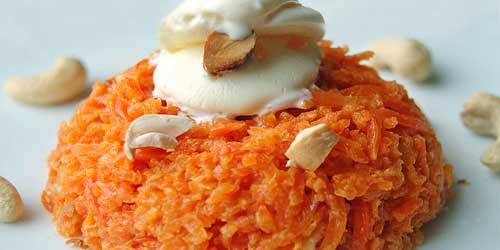
Gajar ko Halwa – Carrot Pudding

Ingredients :

  • 2 kg of carrots
  • 3 cups of whole milk
  • 2 cups of sugar
  • 3 tablespoons of ghee
  • ½  teaspoon of ground cardamom (elaichi)
  • saffron

Preparation :

Grate the carrots.
Place the whole milk, sugar and carrots in a saucepan.
Boil until thickened, stirring constantly once mixture thickens.
Add ghee, cardamom and saffron until it oozes.
Serve hot, garnished with a chopped almond or pistachio.

Astuces : You can eat it with a little yogurt.

Wo – lentil patties

Ingredients :

  • 1 cup of black lentils
  • 1 tablespoon of chopped ginger
  • 1/4 c. teaspoon of asafoetida (Hing)
  • 1/2 c. teaspoon of ground cumin (Jeera)
  • 3 teaspoons of oil
  • Salt

Preparation :

Soak black lentils in water overnight, until the black film is easily removed and remove it.
Mix in the blender the lentils with a little water until obtain a dough, add spices and mix well.
Heat a lightly oiled pan and make a cakes of small shape (like a pancake) with lentils dough. Let brown on both sides and serve hot.

Astuces : Asafoetida helps digestion and is also an “anti-flatulence”. Its smell is very strong and unpleasant for people who are not accustomed to this odor, but when it is cooked it perfumes the dishes.