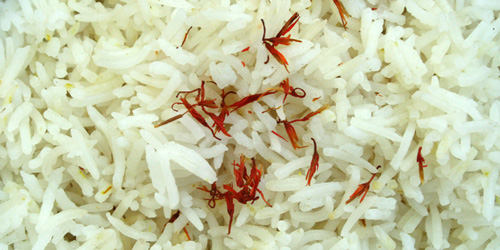
Mattar Pilau – Rice with peas

Ingredients :

  • 1 tablespoon of ghee or oil
  • 4 cloves
  • 1 small cinnamon stick
  • 2 capsules of cardamom
  • 1 teaspoon of cumin seeds
  • 1/2 teaspoon of turmeric powder
  • 1 1/4 cup of long grain rice
  • 1 1/4 cup of peas
  • 2 teaspoons of salt
  • 2 1/2 cups of hot water

Preparation :

Heat ghee in a pan and fry the cloves, cinnamon, cardamom and cumin.

After one minute, add turmeric and rice, and cook, stirring. Add peas, salt andwater and bring to a boil over high heat. Cover and cook 25 minutes over low heat.

Remove lid, stir gently with a fork and remove the cloves, cinnamon stick andcardamom capsules.

Serve hot.

Asian Fruit Salad

Ingredients :

  • 1 watermelon
  • 1 can of lychees or fresh lychee
  • 1 can of longans
  • loquat or tangerine
  • 1 melon

Preparation :

Take a medium sized watermelon and cut the top third.

Scoop out the flesh with a spoon and make balls. Discard the seeds.

Mix the watermelon balls with one or more of the following fruits: lychees, longans, melon balls, loquat or mandarin, then add a little syrup contained in the boxes.

Mix, then cover and chill at least 3 hours in the refrigerator and serve.

Astuces : You can if you want to add some chow chow or any other fruits. You can also make the syrup with juice of 2 oranges and 1 lemon.

Namkin chawal – Indian white rice

Ingredients :

  • 1 1/4 cup of long grain basmati rice
  • 2 teaspoons of ghee
  • 2 1/2 cups of hot water
  • 1 teaspoon of salt

Preparation :

Wash rice until water runs clear and drain with a colander.

Heat ghee in a pan, add rice and cook 2 minutes stirring constantly. Add hot water and salt, mix and bring to a boil quickly.

Cover and cook over very low heat for 20 minutes,  without discovering and do not mix. Remove the lid and allow steam to escape, separate grains with a fork. They should be well separated and well-cooked.

Serve with curries or other spicy dishes.

Chapatis – Indian bread

Ingredients :
For 20 or 24 chapatis:

  • 3 cups of whole wheat flour or flour to roti
  • 1 teaspoon of salt
  • 1 tablespoon of ghee or oil
  • 1 cup of lukewarm water

Preparation :
Reserve about 1/2 cup of flour for rolling chapatis.

Pour the remaining flour in a large bowl, add salt and oil or ghee. Pour all the water at once, mix and knead 10 minutes until dough is firm enough (more kneaded, the more light will chapatis).

Roll into a ball and cover with a cloth and let stand 1 hour. If the dough restovernight, the chapatis will be very light and crispy.

Divide dough in making the balls the size of a large walnut, flatten each ball on floured plate, giving it a circular shape as thin as a pancake.

Heat a crepe pan or heavy skillet and cook the chapatis.

Place the chapati on the skillet and cook about 1 minute, cook the other side for 1 minute by gently pressing the edges with a spatula, this promotes the formation of air bubbles and make inflate the chapati. Once they are cooked, wrap in a clean cloth to keep warm.

Serve with butter, dry curries or vegetable dishes.

In India the  pieces of chapati are rolled into cones to be used as a spoon to eat the dhal sauce.

Tips : In India, chapatis are cooked on the tawa (iron plate) and it holds any moment directly over the fire, causing them to swell up like balloons. This little get on the gas flame, holding it with pliers.

Anecdote : In 1857, the British watched a strange practice that some believe could be the signal for the outbreak of the Indian Mutiny. A chain was formed, perhaps from Kampur, as follows: each village guard, called chaukidar, preparing chapati ten of which he gave a pair to another chaukidar, reaching five villages, all villages in the valley Ganges and being joined in ten days. Some think that this is the method used to transmit the signal for insurrection. However, all historians do not agree with this interpretation, and for them the chain then keeps all its mystery, and is perhaps originated in a magic act, religious or otherwise which has not yet been discovered.

Ghee or ghi – clarified butter

Ingredients :

  • 2 pads of sweet butter

Preparation :
The ghee gives it a rich taste, characteristic of the cuisine of Northern India.
Not containing casein, one can, without blackening, bringing it to very high temperatures.
He buys by the box, package or tube, but it is difficult to find commercially.

Heat butter in a saucepan over low heat. Choose a pot with a thick, heavy bottom (preferably).

Remove the foam with a spoon.
Once the butter has melted, place over medium heat (continue to remove the foam).
After 20 minutes, the liquid separates from the solid, which remains at the bottom. Stop the cooking.

Filter to collect the liquid.

Tips: The ghee will keep for 3 or 4 months at room temperature in an airtight jar.

Sung choi boa

Ingredients :

  • 400 g of ground beef
  • 1 iceberg lettuce
  • 2 green onions
  • 1 onion
  • 2 cloves garlic
  • 1 carrot
  • 1 ginger
  • 4 shiitake mushrooms fresh or dried
  • 100 g of soy bean
  • 50 g of coriander
  • 1 tablespoon of vegetable oil
  • 1 teaspoon of sesame oil
  • 4 tablespoons of oyster sauce
  • 2 tablespoons of rice wine of Shaoxing
  • 1 teaspoon of sugar

Preparation :

Remove with a knife by cutting a few leaves to the base of the lettuce.

Mince the garlic, chop the coriander, peel carrot and ginger and cut into julienne and the shiitake mushrooms also, slice the green onions and diced the onion.

When the wok is hot pour the oil, add garlic, ground beef, onion and shiitake then stir and cook 5 minutes.

Add the sugar, rice wine of Shaoxing and oyster sauce and mix, bring to a boil and cook for 5 minutes over high heat until the sauce reduces slightly.

Finally add the sesame oil, carrots, bean sprouts, green onion, stir and then sprinkled with chopped coriander and serve immediately on a lettuce leaf.

Anecdote : A story was spread around China that Qianlong Emperor (乾隆皇帝 Ching Dynasty) also commended this dish during one of his visits to Jiangnan. Well, it’s only a legend, yet many Chinese restaurants named this dish “Qianlong San Choi Bao” (乾隆生菜包) in their menus to attract more customers.

Caramel pork stew with eggs

Ingredients :

  • 600 g of pork loin
  • 1 clove garlic
  • 5 kaffir leaves
  • 4 eggs
  • 1 star anise flower (flower badian)
  • 3 tablespoons of brown sugar or caramel liquid
  • 2 tablespoons of nuoc mam sauce
  • 2 tablespoons of dark soy sauce
  • 2 glasses of water
  • vegetable oil, black pepper, salt

Preparation :

Cook the eggs in water for 20 minutes. Removing the shells and placed in a bowl of cold water, and set aside.

Cut meat into pieces then peel and chop the garlic.

Heat in a saucepan 1 tablespoon of oil, add garlic and meat and stir occasionally until meat is brown.

Remove meat and reserve.

Put the brown sugar, soy sauce, nuoc mam sauce and star anise to the pan and let simmer over medium heat until boiling.

Put the meat, pepper and stir then add 2 glasses of water and let simmer for 40 minutes until meat is tender.

Then add the boiled eggs and let simmer until you can detach the meat filament (15 minutes).

Serve with white rice.

Tips : after putting the boiled eggs you can add 1 ½ glasses of water during cooking as the sauce reduces and become very salty.

Onigiri with tuna

Ingredients :

  • 2 cups of Japanese rice
  • 2 cups ½ of water
  • 160 g of tuna in brine (1box 1/2)
  • 2 tablespoons of mayonnaise
  • a sheet of nori seaweed
  • ½ teaspoon of salt

Preparation

Cook rice with water in a rice-cooker, transvase when cooked it in a bowl and let cool for 10 minutes at room temperature.

Drain tuna and crumble then put it in a bowl, add the mayonnaise and salt, mix well carefully.

Moisten your hands with some water, take rice and made ​​a small hollow in the middle, put a teaspoon inside of tuna and closed the rice then give a triangular or round shape.

Cut rectangles of approximately 3×6 cm in the nori, moisten them with a little water and then paste them in the bottom or top of each onigiri.

Astuces : They are usually filled with a very salty dried plum (umeboshi), but they may also containother ingredients such as tuna here.

Fish pancakes and cucumber salad


Ingredients :

for 24 pancakes

  • 500 g fillet of white fish
  • 100 g of beans or green beans meter
  • 5 kaffir leaves
  • 2 eggs
  • 1 red chili
  • 1 shallot
  • ½ cucumber
  • 1 tablespoon nuoc mam sauce
  • 1 tablespoon of red curry paste
  • 1 tablespoon of sugar
  • 1 teaspoon of salt
  • 1 tablespoon of rice wine vinegar
  • 12 cl of hot water
  •  oil

Preparation :

Chop the beans and chop very finely kaffir leaves (remove the center rib of the leaves of kaffir). Cut the fish fillet into cubes.

Mixed fish, curry paste, eggs and chopped kaffir leaves, the mixture must be uniform. Put it in a bowl and add chopped beans, sauce, fish sauce and mix.

Heat oil over high heat.

Shape into patties not too big so that the cooking is well blended and flatten slightly to make pancakes.

Put them in the oil and fry 3 minutes on each side, then remove them and drain them well on absorbent paper.

For the cucumber salad:

Cut the cucumber in 2 and finely chop the shallots and red chili.

For the vinaigrette in a bowl, put the sugar, salt, rice vinegar and the warm water and dilute the whole.

Put the cucumber and shallot in a bowl and pour the vinegrette then mix.

tips: you can eat pancakes with sweet chili sauce, serve with salad.

Dashimaki Tamago – Rolled Omelet

Ingredients :

  • 5 eggs
  • 5 ml of water
  • 1 teaspoon of dashi
  • 3 tablespoons of powdered sugar
  • 1 teaspoon salt
  • 1 teaspoon of Japanese soy sauce
  • 1 tablespoon of cooking oil

Preparation :

In a small saucepan, pour water, dashi, sugar, salt and soy sauce and heat over medium heat, stirring to dissolve all without boiling.

Turn off the heat when everything is dissolved and let cool.

Break the eggs in a bowl and mix lightly, add the cold broth and mix without beating.

Lightly oil a frying pan, heat it over medium heat and spread the oil with a paper towel folded, that you will reuse later to lightly oil the pan again.

When the pan is hot, still over medium heat pour a small amount of egg mixture that you spread for make a pancake, to 2 or 3 mm thick. Cook being careful not to fry the egg pancake, until it be cooked but still a bit runny on top.

Beginning on the top of the pan, roll the pancake over itself to you. Push the roll obtained at the top of the pan. Pour back some of the mixture, just enough to make a new pancake.

Again by repeating the same process, until no more egg mixture. Wait until they cool a little then cut them.

Astuces : Traditionally, this is a sweet and salty dish, but you can leave out the sugar.

Tom Yam Kung (Shrimp Soup)

Ingredients :

  • 12 raw shrimp
  • bulb of lemongrass
  • 2 kaffir leaves
  • 3 red chilis
  • 1 lime
  • 1 galangal
  • 1 L of water
  • 50 g of coriander
  • 2 tomatoes or 100 g of cherry tomatoes
  • 1 box of straw mushrooms
  • 1 cube of chicken broth
  • 2 tablespoons of nuoc mam sauce
  • 1 tablespoons of Thai chili paste
  • 1 ½  tablespoons of sugar

Preparation :

Flatten citronella and cut them diagonally, then remove the stem leaves of kaffir.Cut into thin slices galangal and tomatoes into quarters and mushrooms in half.

In a large saucepan put 1 L of water, the chicken broth, the bulb of lemongrass, kaffir leaves, galangal and cook over high heat until boiling.

Shell the shrimp, leaving only the tail and then incise the back of the shrimpand remove the black vein. Add the mushrooms and shrimp in the pan and let simmer 10 minutes.

In a bowl put the chilli paste, add a little broth to dilute well then pour into the pan and add the nuoc mam sauce, the sugar and mix.

Flatten red chilis and cut them diagonally and add them and the tomatoes to the pan then let simmer 5 minutes over medium heat.

Sprinkle with cilantro and serve

Astuces : if the soup needs more salt, add the nuoc mam sauce but no salt. You can use prawns instead of shrimps.