oh ah chian – oh chien – oyster omelet

Ingredients :

  • 30 small fresh oysters
  • 110g of sweet potato flour
  • 25 cl of water
  • 2 large eggs
  • 2 onions, chopped
  • 1 tablespoon of chopped chives
  • 4 tablespoon of cooking oil
  • 3 cloves garlic
  • 2 shallots
  • 1 tablespoon of chili paste
  • 1/2 tablespoon of ground coriander
  • salt, pepper

Preparation :

Dip the oysters in water.
Mix sweet potato flour, salt and water, you must have a liquid paste and reserve.
Add 2 tablespoons of oil in a skillet or wok, add onions, cilantro and chopped shallots and sauté a few minutes. Add oysters to the mix. Cook for a minute.Ajouter eggs and batter mix.
Prepare the sauce by mixing chilli and garlic cloves, finely minced.

Add salt and pepper. Sprinkle with chives. Stir and serve with chilli garlic sauce

Anecdotes: Oh-Ah means oyster. Since this dish from Fujian, China, it is also popular in places with Fujian influences, such as in Malaysia, Singapore, and Taiwan (where it is often sold in night markets).

Ba wan – meat ball

Ingredients :

about 15 meatballs

For the skin:

  • 1 cup of rice flour
  • 400 g of yam flour
  • 6 1/5 cup of cold water

For the filling:

  • 400 g of minced pork
  • 8 dried shiitake mushrooms
  • 170 g dried bamboo shoots
  • 2 tablespoon of dried shrimp
  • 1 tablespoon of fried onion
  • 2 tablespoons of oil
  • 4 cloves garlic, minced

Marinades for pork:

  • 1 1/2 tablespoon of soy sauce
  • 1 teaspoon of sugar
  • 1/4 teaspoon of powder pepper
  • 1 tablespoon of cornstarch

Seasonings:

  • 1 tablespoons of cooking wine
  • 1 tablespoon of soy sauce
  • 1/2 teaspoon of salt
  • 1/4 teaspoon of 5 spice

For the sauce:

    • 2 tablespoons of rice flour
    • 1 1/2 cups of water
    • 1 tablespoon of sugar
    • 1 tablespoon of Miso
    • 2 tablespoons of tomato ketchup

Preparation :
Mix rice flour and cold water in a saucepan. Whisk until all the rice flour is dissolved in water. Cook mixture over medium heat, stirring constantly until it begins to boil and thicken like glue. It takes about 30 minutes. Remove from heat and let cool and set aside.

To prepare the toppings. Marinate the ground pork with soy sauce, sugar, pepper and cornstarch for 2 hours.

Soak the dried mushrooms until wilted and dried bamboo shoots for 20 minutes, then blanch in boiling water. Soak the dried shrimp for 20 minutes.

Heat a pan with 2 tablespoons oil, add garlic, dried shrimp and mushrooms and saute 1 minute. Add the marinated pork and cook until pork is no longer pink. Add bamboo shoots and stir fry for 1 minute. Season with cooking wine, soy sauce, 5 spice, fried onions and salt. Stir and remove from heat and set aside.

Prepare small bowls and grease with a little oil. Sift flour yam. Add yam flour sifted into the mixture of glutinous rice that had cooled a little bit.
Initially, the texture has a rough appearance. Continue to mix until a smooth paste. Fill greased bowl with 2-3 tablespoons of mixture and spread it in the bowl.

fill to the brim , cover filling with the rice mixture and ensure that all the filling is covered. Repeat until all mixture is used.

Bring a saucepan of water to a boil. Place the bowls in a steamer basket and cook for 15 minutes.

Meanwhile, prepare sauce by mixing in a small pan, the rice flour, water, sugar, miso and ketchup. Cook over medium heat, stirring constantly, until a thick and sticky. The sauce will thicken.

When the cooking is complete, remove from heat and let cool for several minutes until dough is firmer.
Use a butter knife to unmold the meatball then use scissors to make an x by cutting above meatball.
Drizzle with sauce and sprinkle with chopped parsley and serve.

Tips : The stuffing varies in different regions of Taiwan. It can also be fried after have unmold the meatball.

Anecdotes: It is believed that ba-wan was first prepared in Beidou Township of Taiwan by a student named Fan Wànjū. She served as food for disaster relief from heavy flooding during the late Qing Dynasty (1644-1912). Since then, ba-wan has spread in different regions of Taiwan and is now considered by many as a national food.

San bei ji – three cup of chicken

Ingredients :

  • 400 g of chicken
  • a piece of fresh ginger 2 cm
  • 2 onions
  • 1 tablespoon of sugar
  • 4 tablespoons of soy sauce
  • 4 tablespoons of rice wine
  • 4 tablespoons of sesame oil
  • few basil leaves
  • 1 chile

Preparation :

Peel the ginger and cut into julienne. Cut finely onions. Cut chicken into medium pieces.

In a bowl mix, the ginger, wine, soy sauce, sugar, sesame oil and set aside.

Heat skillet with 1 tablespoon of oil, saute the chicken pieces over high heat for 1 minute, add sauce and reduce heat to medium. Cover and cook for 15 minutes.

When the liquid has evaporated add the onions, basil leaves and half the chilli cut into small pieces and seeded then mix.

Place a basil leaves for decoration and the rest of chili.
Serve with rice.

Tips : You can replace the chicken with pork or frog legs.

Anecdotes : San bei ji is a popular recipe in Chinese cuisine. The dish is from Jiangxi province in southern China, and is a specialty of Ningdu. However, it has become particularly popular in Taiwan, so it is said: “A restaurant who can not do San beiji is not a real restaurant in Taiwan. Its name literally translates as “three cup of chicken”, referring to the sauce used for this.

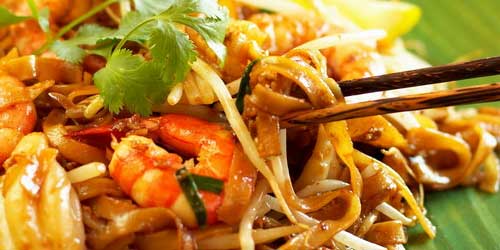
Char kway teow – fried noodles

Ingredients :

  • Oil
  • 2 cloves garlic, minced
  • 1 tablespoon of Sambal oelek (chilli paste)
  • 2 Chinese sausages, sliced ​​
  • 250 g of peeled and deveined shrimp
  • 500 g of fresh rice noodles
  • 1/4 cup of soy sauce
  • 1 tablespoon of brown sugar
  • 2 eggs beaten
  • 1 cup of mung bean sprouts
  • 3 spring onions chopped

Preparation :

Heat oil in a wok on high heat, add garlic and sambal oelek and fry for about 30 seconds. Add the Chinese sausage and shrimp and saute until shrimp are almost cooked.

Reduce heat to medium and add rice noodles then stir and scraping the bottom of the wok to prevent it sticking, then add soy sauce and brown sugar.

Make a hole in the center of the wok, pour in the beaten egg and let cook then mix everything with the noodles.

Add scallions and cook, stirring frequently.

Salt and pepper and serve.

Tips : You can add shallots (with garlic), chicken ground meat, squid, clams, cockles, crab meat or tofu, brussels sprouts, Chinese cabbage shredded, bok choy, spinach and other greens vegetables or germinated seeds. Add 1 or 2 tablespoons oyster sauce instead of sugar if you desired. You can also use dried noodles, in this case rehydrate 20 minutes before use.

Anecdote : Of all versions notable, the style of Penang of char kway teow is the most famous. Its popularity led many sellers out of Penang to call their products “Penang Koay Teow” to attract customers.
In the past, he used to blow the kway teow char in pork fat without eggs (which were however available on request). More recently, ordinary cooking oil is commonly used for religious or health reasons, and eggs have become a standard ingredient in the dish. This very popular dish bears many names, exemple : char kueh teow, char kueh tiao …

Murtabak – martabak – pancake stuffed

Ingredients :

  • 2 tablespoons of ghee
  • 4 eggs
  • 1 cup of flour
  • 3/4 teaspoon of salt
  • 1/2 teaspoon of freshly ground black pepper
  • 1/4 teaspoon of baking powder
  • 1 glass 1/2 water

Garnish :

  • 600 g of mutton chopped
  • 1 teaspoon of salt
  • 1/4 teaspoon of turmeric powder
  • 8 diced onions
  • 20 cardamoms seeded
  • 2 tablespoons of toasted coriander seeds
  • 1 tablespoon of anise

Preparation :

Fry the turmeric with a little oil and set aside. Cook the lamb and diced onions over low heat and add cardamom, coriander, anise and salt. Reserve.
Mix flour and baking powder in a bowl with a glass and a half of water. Knead into a smooth paste, cover the bowl and let dough rest for the night.

Divide dough into 4 equal portions. Spread it thinly on an oiled marble or a cutting board glass, then add the ghee. Fold and shape into balls then cover the dough with a damp cloth. Let stand 1/2 hour.

Flatten finely the dough into rectangle, place the garnish evenly in the center of the dough, brush over lightly beaten egg over the meat. Wrap the dough over the meat to form a square. Fry in oil until brown on both sides. Serve hot.

Tips : It is often eaten with the curry sauce.

Anecdotes : The Murtabak comes from India, and its trace back to the Sultanate of Delhi (1206-1526). Accompanying the traders, the murtabak aired in many Asian countries of south-west, and remained a popular dish in many of these regions. In Malaysia, it is nicknamed “Mamak” by malaysians. In Indonesia, especially Jakarta, it is called “Martabak”. It comes in two versions, savory and sweet dish. This dish is also eaten in Saudi Arabia and Yemen where it is called “Mutabbaq”.

Phulkopir Paturi – cauliflower mustard

Ingredients :

  • 1 cauliflower cut into small florets
  • 2 potatoes, diced
  • 1 onion diced
  • 1 tomato finely chopped
  • 4 green chillies finely chopped
  • 2 tablespoons of grated coconut
  • 1/2 tablespoon of turmeric,
  • 2 tablespoons of mustard seeds
  • 3 tablespoon of poppy seeds
  • 1 tablespoon of minced garlic
  • 3 cups water
  •  Oil
  • Salt

Preparation :
Blanch the cauliflower pieces and potato for 5 minutes. Drain in a colander and reserve.
Grind the grated coconut with garlic then add the poppy seeds, mustard seeds and turmeric. Then add the chopped onions, tomatoes and chilies.

Heat oil in a saucepan over low heat. add spices and vegetables and stir for 2-3 minutes, stir evenly, then add a little water to prevent it adheres.
Cover pan and return the mixture from time to time.
If the content looks too dry, not cooked, add a little water.
Bake for 25-30 minutes until the mixture begins to brown.

Tips: This cooking style is classic of Bhutan. Small amounts of water added as and when measured on a relatively low heat.

Jasha Maroo – minced chicken

Ingredients :

  • 1 chicken or tenderloin
  • 2 tablespoon of vegetable oil
  • 2 cloves garlic
  • 1 onion
  • 1 tomato
  • 5 cm of ginger
  • 3 green chillies
  • salt
  • 3 cup of water
  • coriander leaves

Preparation :

Cut chicken into very small pieces and minced onion.
Saute the onion with the oil in a pan, then put the chicken and add water, bring to boil.
Cut the garlic and crush then chop the tomato, ginger and green chillies.
Add garlic, tomato, chilies, salt and ginger, cook over low heat.
The dish should have a little juice when done.
Garnish with cilantro and serve with rice.

Kewa Phagsha – spicy pork with potatoes

Ingredients :

  • 350 g of pork into pieces
  • 2 potatoes
  • 3 green chilies
  • 1/2 onion
  • 1/2 teaspoon of chili powder
  • 3 cloves garlic, crushed
  • 1 piece of ginger finely chopped
  • 1/2 tablespoon of cooking oil
  • 50 g of chopped cilandro
  • 40 cl of water

Preparation :

Put 40 ounces of water in a saucepan, add the pork and a little salt and boil for about 20 minutes, the pork should be cooked thoroughly.

Cut the potatoes into 6 or 8 pieces, then cut the chilies into 2 in lengthwise.

Add the chilli, potato, onion, and 1/2 teaspoon of oil and simmer until potato is cooked.
Stir in garlic, ginger, and chili powder and cilantro. Salt and pepper.

Serve.

Tips : Adapt the chili to your taste, In Bouthan it is used as a vegetable.

Phaksha Pa – Pork with Vegetables

Ingredients :

  • 1 medium onion
  • fresh ginger
  • medium daikon or radish
  • 40 g of butter
  • 1 boneless pork shoulder, cut into 6
  • 1/2 cup of water
  • 2 tablespoons of chili powder
  • 2 teaspoons of salt
  • 3 large bok choy (stalks and leaves cut into strips)
  • 170 g of dried pork cut into 3
  • 1 large green chili, seeded and julienned

Preparation :

Coarsely chop the onion and finely chop the ginger and set aside.
Melt butter in large saucepan, add the pork shoulder, onion, radish, water, chili powder, salt and simmer over low heat until the pork is tender, about 1:25.
Meanwhile, cook the bok choy in a saucepan of boiling water until tender and to drain.
Add the ginger, bok choy, dried pork, and chili to stew and simmer over low heat 5 to 10 minutes.

Serve.

Anecdotes: In Bhutan the dried pork is considered a healer and is a staple in the cooking.

Fing pork – pork with noodles and chilli

Ingredients :

  • 1 package of chinese noodles
  • 1 medium onion, peeled and cut into wedges
  • 1 tomato
  • 110 g of butter
  • 700 g of pork shoulder, cubed
  • 1/2 cup o water
  • 3 green chillies, seeded and julienned
  • Salt and freshly ground black pepper

Préparation :

Soften noodles in a bowl of boiling water for 2 minutes. Drain and cut every 15 cm. Coarsely chop the onion, then reserved.
Coarsely chop tomatoes.
Melt butter in large saucepan, add onion, tomato, pork, and water, then let simmer over low heat 30 minutes.

Add the noodles, chilies, salt and pepper and simmer about 10 minutes.

Serve hot.

Thukpa – noodle soup with vegetables

Ingredients :

  • 400 g of egg noodles
  • 200 g of mixed vegetables (carrots, potatoes …)
  • 200 g of spinach, washed and chopped
  • 1 onion, chopped
  • 2 tomatoes
  • ½ Yogurt
  • 1 clove garlic
  • 1 tablespoon of chopped ginger
  • ½  teaspoon of turmeric
  • 1 teaspoon of cumin powder
  • ½ teaspoon of thyme
  • 3 fresh chilies
  • 1 bay leaf
  • 4 teaspoons of soy sauce
  • 2 cups of vegetable broth
  • 2 tablespoons of mustard oil (or vegetable oil with mustard)
  • Salt and pepper to taste
  • 1 tablespoon chopped cilantro

Preparation :

Peel and cut carrots into rounds and potatoes into 6 pieces and set aside.
Cook noodles in boiling salted water then drain, rinse and reserve.

In a pan heat two tablespoons of mustard oil, add onions, fry until light brown.
Add the cumin, turmeric, garlic, ginger, and chilies, stir well for 1 or 2 minutes.Then add the vegetables and cook for 10 minutes.

Add tomatoes, soy sauce, yogurt, broth, thyme, bay leaf, salt and pepper to vegetables and cook until vegetables are tender.
Add the noodles and spinach into the stew and cook for 1 or 2 minutes longer.
Garnish with chopped cilantro and serve.

Anecdotes : In Tibet, the Thukpa is one of the main dish is served and the Tibetan New Year, during the celebration “Losar” (Lo = year, Sar = new). It is based on the lunar calendar. It is also found in Bhutanese cuisine.

Emadatse – stew chili and cheese

Ingredients :

  • 12 chilis serrano or Thaï
  • 2 jalapeno chili
  • 3 tablespoons of ghee
  • 1 onion, chopped
  • 3 mushrooms diced
  • 4 cloves garlic, minced
  • 2 tomatoes, peeled and diced
  • 2 tablespoons of finely chopped ginger
  • 2 teaspoons of salt
  • 1 cup of feta or crumbled farmer cheese
  • 1 cup of fresh cilantro chopped

Preparation :

Cut the chilis lengthwise and remove seeds under running water. Coarsely chop all the chilis and reserve.

Cook onion, mushrooms and garlic over medium heat for about 5 minutes until onion is translucent. Add the chilis, tomatoes, ginger and salt, mix well and cook for about 7-10 minutes, until chilis are slightly scorched, then add cheese and cook, stirring constantly until melted.

Garnish with cilantro and serve warm or lukewarm with rice.

Anecdotes The Emedaste is the national dish of Bhutan, there are many variety. Here, the chilis is used as a vegetable not a spice.